
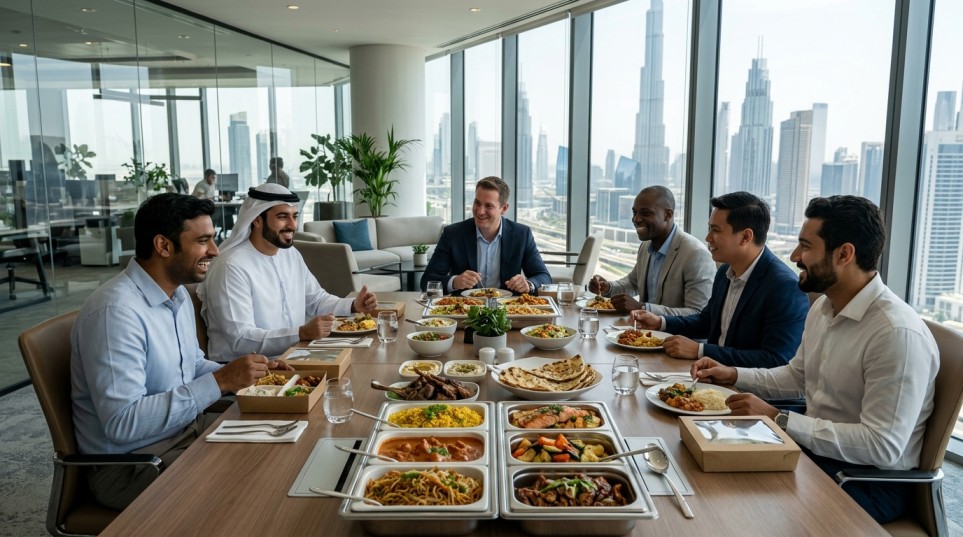
A daily office lunch program is a recurring corporate meal service that delivers freshly prepared food to your office premises on a scheduled basis, typically 5 days per week. In Dubai, these programs cost between AED 25 and AED 75 per person per day depending on the service model, menu complexity, and order volume.
Dubai employs a workforce spanning over 200 nationalities. Summer temperatures regularly exceed 45°C, making outdoor lunch breaks impractical for nearly 6 months of the year. These factors make daily office lunch programs one of the most practical employee benefits a company operating in Dubai can offer.
HR managers, office managers, and procurement officers leading this decision will find the evaluation framework, compliance requirements, and implementation steps in this guide immediately actionable.
This guide covers everything — from program models and realistic costs to Dubai Municipality compliance requirements, vendor selection frameworks, step-by-step implementation, and measurable business ROI.
What Is a Daily Office Lunch Program?
A daily office lunch program is a structured arrangement where a business contracts a catering company to deliver meals to the office every working day. The employer pays a fixed rate per employee per day, and fresh meals arrive at a scheduled time — usually between 11:30 AM and 1:00 PM.
This differs fundamentally from one-time event catering, individual meal subscriptions, or restaurant lunch allowances. A daily office lunch program is a business-to-business (B2B) arrangement where the company purchases meals as a structured workplace benefit for its entire team.
These managed meal solutions serve offices with as few as 10 employees up to 500 or more. The catering partner handles menu planning, preparation, packaging, temperature-controlled delivery, and dietary customisation across the workforce.
Daily lunch programs function as non-monetary compensation — a visible, daily benefit that strengthens company culture, reduces time waste, and supports employee wellness simultaneously.
📌 Key Fact: According to the Society for Human Resource Management (SHRM), 56% of employees consider food-related benefits a significant factor when evaluating job offers. Source: SHRM – Employers Enhance Food Benefits
Daily Office Lunch Programs vs Other Corporate Food Solutions
Before committing to a daily lunch program, businesses operating in the UAE need to understand how this model compares to other options.
| Feature | Daily Lunch Program | Event Catering | Restaurant Allowance | Individual Subscription |
|---|---|---|---|---|
| Frequency | Daily (weekdays) | One-time/occasional | Daily (individual choice) | Daily (individual) |
| Cost Control | High (fixed per-person rate) | Variable | Low (unpredictable) | Medium |
| Dietary Management | Centralised | Limited | None | Individual |
| Team Bonding | Strong (shared meals) | Moderate | Weak | None |
| Admin Burden | Low (single vendor) | High | Medium (reimbursements) | Low |
| Scalability | High | Per-event | Difficult to track | Per-individual |
| Budget Predictability | Fixed monthly cost | Unpredictable | Varies per employee | Per-individual |
A structured daily lunch program gives businesses the highest level of cost predictability and dietary management while creating natural team bonding moments that ad-hoc restaurant allowances cannot replicate.
💡 Tip: Companies currently providing AED 50–60 per day in restaurant allowances often discover that switching to a structured program at AED 35 per person delivers better food quality, higher participation, and AED 15–25 savings per employee per day — while eliminating reimbursement administration entirely.
Types of Daily Office Lunch Program Models Available in Dubai
Four primary service models operate across Dubai’s corporate catering market. Each suits different office sizes, budgets, and infrastructure setups.
Packed Lunch / Individual Box Delivery
Individually portioned meals arrive in sealed, labelled containers. Each staff member receives their own box containing a complete meal — protein, carbohydrate, vegetable, and sometimes dessert or a drink.
Best for: Offices without kitchen facilities, teams of 10–50 employees, companies in Business Bay, JLT, and TECOM tower offices Cost range: AED 25–45 per person per day
Advantages:
- Portion control built into every meal
- Dietary labels and allergen indicators visible on each box
- No serving staff or dedicated dining space required
- Minimal setup and zero cleanup responsibility
- Works for offices across all Dubai commercial districts
Limitations:
- Less variety compared to buffet formats on any single day
- Limited hot-food options from some providers during long delivery routes
Buffet-Style Daily Catering
The catering partner delivers and arranges food in serving stations within your office dining area or pantry. Employees serve themselves from multiple options, creating a self-service station experience.
Best for: Offices with 50+ employees and a dedicated dining space Cost range: AED 35–65 per person per day
Advantages:
- Greater variety with 4–6 dishes available daily
- Accommodates Arabic, Indian, Continental, and Asian cuisines simultaneously
- Encourages social interaction and team cohesion during meals
- Feels like a complete corporate dining experience
Limitations:
- Requires physical space for buffet setup
- Potential for food waste with unpredictable daily headcount
- May require serving equipment investment from the company
Canteen Management / Managed Dining
A full outsourced canteen operation where the catering company manages an on-site kitchen within your office building. They handle staffing, cooking, serving, and cleanup — a complete managed meal solution.
Best for: Large offices with 200+ employees, corporate towers, free zone buildings Cost range: AED 45–75 per person per day (includes kitchen staffing)
Advantages:
- Maximum freshness — food prepared on-site minutes before serving
- Live cooking options available (made-to-order stations)
- Complete dining experience for the workforce
- Highest level of menu customisation possible
Limitations:
- Requires existing kitchen infrastructure on premises
- Higher minimum commitment and longer contract periods
- Highest cost among all models
This model is common in large free zone offices across JAFZA, DAFZA, and DIFC where building management supports centralised dining facilities. Companies in Dubai Silicon Oasis and Al Quoz creative districts also use this model for large teams.
Hybrid / Flexible Model
A technology-driven model combining pre-ordering through a mobile app with rotating delivery formats. Employees select their meals in advance via a digital menu, and the caterer prepares exactly what was ordered — eliminating waste.
Best for: Companies with hybrid work models, teams with fluctuating daily headcount Cost range: AED 30–55 per person per day
Advantages:
- Adapts to changing daily office attendance automatically
- Reduces food waste significantly through demand-based preparation
- Employees receive personal choice within curated options
- Integrates with existing ERP systems for automated billing in some platforms
- Works for hybrid and remote-flexible teams
Limitations:
- Requires technology adoption from all team members
- Morning cut-off times (typically 9:00–10:00 AM) must be respected
- Less spontaneous than buffet options
How Much Does a Daily Office Lunch Program Cost in Dubai?
A daily office lunch program in Dubai costs AED 25 to AED 75 per person per day, depending on the program model, cuisine complexity, contract terms, and team size.
Here is a clear pricing breakdown for a team of 30 employees over 22 working days per month:
| Program Model | Cost Per Person/Day (AED) | Monthly Cost (30 Employees) |
|---|---|---|
| Packed Lunch Delivery | 25–45 | AED 16,500–29,700 |
| Buffet-Style Catering | 35–65 | AED 23,100–42,900 |
| Canteen Management | 45–75 | AED 29,700–49,500 |
| Hybrid/Flexible | 30–55 | AED 19,800–36,300 |
Monthly Budget Calculation Formula
Use this formula to calculate your monthly corporate meal budget:
(Number of employees) × (Cost per person per day) × (22 working days)
Example: 30 employees × AED 35 × 22 days = AED 23,100 per month
Real-world comparison: A 45-person fintech company in DIFC transitioned from individual restaurant allowances averaging AED 55 per employee per day to a structured packed lunch program at AED 35 per person. The result: AED 19,800 in monthly savings while team lunch participation increased from 40% to 89%.
⚠️ VAT Note: All corporate catering services in the UAE are subject to 5% Value Added Tax (VAT). Confirm whether quoted prices are VAT-inclusive or exclusive to avoid unexpected budget overruns on your total monthly spend.
Factors That Influence Pricing
Several variables affect what your business will actually pay:
- Cuisine complexity — Multi-cuisine menus rotating Arabic, Indian, Continental, Filipino, and Asian options daily cost more than single-cuisine offerings
- Dietary customisation level — Individual calorie-controlled meal plans tailored per person cost more than a standard set menu for everyone
- Delivery distance — Offices far from the caterer’s central kitchen may attract delivery surcharges; offices in central Business Bay or Downtown Dubai typically avoid these
- Order volume — Larger teams unlock bulk discounts, often 10–15% savings above 50 persons
- Contract duration — Annual contracts offer 10–20% lower per-meal pricing versus monthly rolling agreements
- Packaging type — Eco-friendly biodegradable containers may add AED 2–5 per meal
- Serving staff inclusion — Buffet setups with dedicated attendants cost more than contactless drop-and-go packed deliveries
💡 Tip: Always request a fully itemised cost breakdown from vendors. Ask specifically about delivery fees, packaging surcharges, minimum order penalties, and whether the price per head includes beverages or only food. Hidden fees typically add 8–12% above the quoted base rate for businesses that fail to clarify upfront.
Dubai Food Safety and Compliance Requirements for Office Catering
Any catering company delivering food to offices in Dubai must comply with strict Dubai Municipality food safety regulations. As the employer arranging these meals, your business carries a duty of care toward staff. Verifying your catering partner’s compliance protects the company from liability and your team from health risks.
Dubai’s corporate catering market operates on thin margins — typically 8–15%. This means aggressive price negotiation below market rates often results in quality and safety compromises within 2–3 months. Compliance verification is your primary safeguard against this risk.
📌 Key Fact: Dubai Municipality’s Food Safety Department conducts over 100,000 inspections annually to ensure food establishments comply with local food safety codes and UAE Federal Law No. 10 of 2015 concerning food safety. Source: Dubai Municipality – Food Safety Department
Certifications Your Catering Partner Must Have
Before signing any agreement, verify these certifications — request copies with visible expiry dates:
- Dubai Municipality Food Safety Licence — Mandatory for every food business operating in Dubai. Non-negotiable. No exceptions.
- HACCP Certification — Hazard Analysis and Critical Control Points. This systematic approach identifies, evaluates, and controls food safety hazards throughout production, packaging, and delivery.
- Halal Certification — Issued by the Emirates Authority for Standardisation and Metrology (ESMA) or approved certification bodies. Essential given UAE regulatory requirements and cultural framework.
- Valid Trade Licence — Issued by the Department of Economic Development (DED) or the relevant free zone authority where the caterer operates.
- ISO 22000 (recommended) — International food safety management standard demonstrating world-class safety systems and continuous improvement processes.
- Staff Food Handler Permits — All food handlers must complete Dubai Municipality-approved food safety training and hold valid individual permits.
💡 Tip: A legitimate caterer provides these certificates within 24 hours of request without hesitation. Any delay, excuse, or reluctance to share documentation is a disqualifying red flag — walk away immediately regardless of pricing.
Temperature Control and Delivery Safety in Dubai’s Climate
Dubai’s extreme summer temperatures create a unique food safety challenge that businesses must not underestimate.
The food safety “danger zone” sits between 5°C and 63°C — bacteria multiply to dangerous levels when food remains in this range for more than 2 hours. In a Dubai summer where outdoor temperatures reach 48°C, unprotected food enters the danger zone within minutes of leaving a kitchen.
Your catering partner must demonstrate:
- Temperature-controlled vehicles — refrigerated or professionally insulated delivery vans
- Insulated containers maintaining safe temperatures throughout the entire transit duration
- Time-limited delivery windows — hot food delivered above 63°C, cold food below 5°C at the point of handover
- Documented temperature logs available for compliance verification and food safety audits
- Cold chain management protocols covering the entire journey from central kitchen to office reception
Contactless delivery protocols, established during the pandemic period, remain standard practice among professional caterers and add an additional hygiene layer to the handover process.
This is not optional — it is a fundamental requirement and the single most important differentiator between professional corporate caterers and unreliable operators cutting corners.
Managing Dietary Diversity in Dubai’s Multicultural Workforce
Dubai’s workforce is among the most culturally diverse on earth. Managing dietary requirements across your team is not a nice-to-have feature — it is a necessity for any daily office lunch program to achieve high participation and satisfaction.
📌 Key Fact: The UAE’s expatriate population constitutes approximately 88% of the total population, creating one of the world’s most culturally diverse workforces with distinct dietary requirements spanning religious, cultural, and health-based categories. Source: UAE Government – Population and Demographic Mix
Dietary needs in a typical Dubai office fall into four distinct categories:
- Religious requirements — Halal food (mandatory across UAE), no pork products, observance of fasting periods during Ramadan
- Health conditions — Food allergies (nuts, shellfish, dairy, gluten), intolerances, diabetes-friendly and calorie-controlled portions
- Lifestyle choices — Vegetarian, vegan, keto, paleo, Mediterranean diet preferences
- Cultural cuisine preferences — Arabic, Indian, South Asian, Filipino, Continental, East Asian — employees engage more with familiar flavours
A competent catering partner accommodates all four categories simultaneously through daily menu diversity, clear meal labelling, and cross-contamination prevention protocols.
How to Collect and Manage Employee Dietary Preferences
Follow these practical steps to ensure dietary management runs smoothly from day one:
- Conduct a dietary preference survey during onboarding and repeat quarterly — use Google Forms or Microsoft Forms for easy collection and analysis
- Categorise responses into religious, medical, and lifestyle preference groups
- Share aggregated data (not individual names attached to dietary needs) with your catering partner to protect employee privacy
- Establish a clear labelling system — every delivered meal must display ingredients, calorie count, and allergen indicators using standardised icons
- Create a feedback loop — employees report issues directly to an internal coordinator who communicates with the vendor within the same working day
💡 Tip: Never assume dietary needs remain static throughout the year. People develop new allergies, change lifestyle choices, observe different religious practices seasonally, and experience health changes. Quarterly surveys catch these shifts before they become daily frustrations or safety risks.
How to Choose the Right Daily Lunch Program Provider in Dubai
The cheapest caterer is rarely the best choice for a recurring daily service. Over a 12-month contract, reliability, food quality consistency, and responsive communication matter far more than saving AED 3 per person per day.
Based on current market analysis of 20+ active daily lunch providers in Dubai, the vendors delivering the highest sustained satisfaction share three traits: consistent food quality beyond month three, responsive dedicated account managers, and transparent ingredient sourcing. Understanding how to choose the best corporate catering company in Dubai requires evaluating these traits systematically rather than selecting based on price alone.
A systematic evaluation approach prevents costly mistakes and ensures your personnel receive meals they genuinely enjoy eating every working day.
For teams exceeding 100 employees, issuing a formal Request for Proposal (RFP) to 3–5 shortlisted vendors streamlines the evaluation process and produces comparable, standardised responses for objective assessment.
10 Critical Questions to Ask Before Signing a Contract
- What certifications do you currently hold? — Request HACCP, halal, Dubai Municipality licence, and trade licence copies with visible expiry dates. Expired certificates are equivalent to no certificates.
- What is your minimum order requirement and lead time? — Determines feasibility for your team size and flexibility for growth periods.
- How frequently does your menu rotate? — Minimum 3-week rotation cycle prevents menu fatigue. Weekly rotation with seasonal updates is the gold standard.
- Can you accommodate 5+ dietary categories simultaneously? — Tests their operational capability and kitchen organisation for culturally diverse teams.
- What is your delivery window and punctuality guarantee? — Late deliveries disrupt entire team workflows. Ask for their documented on-time delivery percentage — professional caterers exceed 95%.
- Do you offer a trial period before long-term commitment? — Reputable providers offer 1–2 week trials (5–10 working days). Refuse vendors demanding immediate contractual lock-in.
- What is your cancellation and pause policy? — Critical for Ramadan, public holidays, company events, and periods when meals are not needed. Flexibility here reveals vendor maturity.
- How do you handle food safety complaints or incidents? — Reveals their crisis management maturity. Ask for their documented response procedure and average resolution time — professional caterers respond within 2–4 hours.
- Can you scale from our current team size to double within 6 months? — Ensures they accommodate business growth without service degradation or renegotiation.
- Do you provide a dedicated account manager? — A single point of contact resolves issues 3–4 times faster than generic customer service channels.
Red Flags When Evaluating Catering Vendors
Watch for these warning signs during your evaluation:
- No verifiable certifications, or certificates with expired validity dates
- Unwillingness to provide client references or verifiable testimonials
- No trial period option — insisting on immediate long-term contracts
- Rigid agreements with heavy early termination penalties exceeding 2 months’ value
- Vague or evasive responses about ingredient sourcing and supplier relationships
- No documented system for allergen management or cross-contamination prevention
- Inconsistent delivery times during the trial period (variance exceeding 15 minutes)
- No dedicated point of contact — only generic call centres or chatbots
- Pressure tactics or artificial urgency (“this price expires tomorrow”)
Any single red flag warrants serious caution. Multiple red flags mean you walk away immediately — regardless of attractive pricing.
Step-by-Step: Launching a Daily Lunch Program in Your Dubai Office
Launching a daily office lunch program takes approximately 4–6 weeks from initial decision to first delivery. Understanding the catering process from a provider’s perspective helps businesses set realistic timelines and expectations. Here is the complete implementation framework.
Phase 1 — Internal Assessment (Week 1–2)
- Survey employees on dietary preferences, cuisine interests, preferred meal timing, and willingness to participate
- Assess office infrastructure — dining space availability, kitchen facilities, refrigeration capacity, delivery reception area
- Determine daily headcount — account for hybrid work patterns, remote days, typical Tuesday-Thursday peak attendance versus Monday-Friday variation
- Calculate budget allocation per employee per day using the monthly formula: employees × per-person cost × 22 days
- Define programme goals — Is this primarily for retention, wellness, productivity, convenience, or strengthening company culture? The answer shapes which model suits best.
Phase 2 — Vendor Research and Trial (Week 2–4)
- Shortlist 3–5 vendors based on valid certifications, capacity for your team size, cuisine diversity, and geographic proximity to your office
- Request itemised proposals with per-person pricing, delivery schedules, menu samples, and contract term options for your specific headcount
- Arrange 1-week trials with your top 2 candidates — run them on alternate weeks for direct comparison
- Collect structured daily feedback during each trial covering taste quality, portion size, variety, delivery punctuality, packaging presentation, and temperature on arrival
- Score vendors against the 10 critical questions checklist with weighted criteria matching your programme goals
Phase 3 — Contract and Launch (Week 4–6)
- Negotiate contract terms — duration, pricing locks for minimum 6 months, cancellation clauses, scaling provisions, and performance KPIs with consequences
- Finalise menu rotation schedule — agree on cycle frequency, seasonal updates, and the process for introducing new dishes based on employee feedback
- Set up the ordering system — app-based pre-ordering, email confirmation, or platform-based management depending on your chosen model
- Communicate programme launch to all employees with a clear FAQ covering how to order, dietary options, timing, delivery location, and feedback channels
- Designate an internal coordinator — one person who liaises between employees and the catering partner, consolidating feedback and resolving issues within the same day
- Establish monthly review cadence — scheduled meetings with the vendor to review satisfaction scores, address patterns in feedback, update dietary requirements, and plan menu evolution
💡 Tip: Run your first month as a “soft launch.” Collect feedback daily, address issues within 24 hours, and formalise the programme into a long-term contract only after confirming employee satisfaction scores exceed 80% and delivery punctuality holds above 95%.
Business Benefits and ROI of Daily Office Lunch Programs
A daily office lunch program is a strategic investment with measurable returns — not merely a line item expense. The benefits compound across productivity, retention, health, and culture metrics over time.
📌 Key Fact: Research published by the International Journal of Workplace Health Management found that employees with access to workplace meal programs report 20% higher job satisfaction scores and 12% lower intention to leave compared to those without food benefits. Source: Emerald – International Journal of Workplace Health Management
Productivity and Time Savings
Employees in Dubai typically spend 30–45 minutes leaving the office for lunch — navigating building lifts, parking, traffic, restaurant queues, and returning through security. On-site lunch programmes reduce this to 15–20 minutes of transition time.
Net productivity gain: 10–25 minutes per employee per day.
For a 50-person team, this equals 500–1,250 minutes (8–20 hours) of collective productive time recovered daily. Over a 22-day working month, this translates to 176–440 additional productive hours — time your business would otherwise lose entirely to lunch logistics.
Employees also return energised from a proper balanced meal rather than stressed, overheated, and fatigued from navigating midday traffic in 45°C heat. Afternoon productivity quality improves measurably alongside quantity.
Employee Retention and Talent Attraction
In Dubai’s competitive talent market, non-monetary compensation differentiates employers. A daily lunch programme is a visible, tangible benefit staff experience every single working day — not a quarterly bonus forgotten within a week or an annual reward that blends into background noise.
Companies providing daily meals demonstrate consistent, daily investment in employee wellbeing. This strengthens employer branding for recruitment, reduces voluntary turnover, and creates positive word-of-mouth that attracts candidates organically.
📌 Key Fact: UAE businesses allocating food-related employee benefits report up to 25% reduction in voluntary staff turnover according to regional HR surveys conducted across GCC markets. Source: Gulf Business – UAE Employee Benefits Trends
Team Cohesion and Workplace Culture
Shared meals create natural, informal interaction opportunities that scheduled meetings and email threads cannot replicate. When colleagues from different departments eat together daily, departmental silos break down organically without forced team-building exercises.
Cross-functional relationships develop through lunch conversations. New team members integrate faster into company culture. A sense of belonging and community strengthens when people share food together — a deeply ingrained social behaviour across every culture represented in Dubai’s workforce.
Health and Wellness Impact
Nutritionally balanced, chef-prepared meals reduce employee reliance on fast food outlets, vending machines, and sugary convenience options from nearby shops. Controlled portions support healthier eating habits without requiring individuals to calorie-count or meal-prep independently.
Long-term measurable benefits include:
- Fewer sick days and lower absenteeism rates
- Better mental clarity and focus during afternoon working hours
- Reduced decision fatigue — employees no longer expend mental energy daily deciding what to eat
- Improved energy levels from balanced nutrition versus heavy restaurant meals
- Lower healthcare-related costs over multi-year periods
Common Challenges and How to Overcome Them
Every daily lunch programme encounters operational challenges. Anticipating these issues and building solutions into your programme structure from day one prevents most problems before they surface.
Menu Fatigue and Repetition
Problem: Employees lose enthusiasm after 4–6 weeks when they recognise repeating menu cycles. Participation drops. Complaints increase.
Solution: Require a minimum 3-week menu rotation cycle in your contract. Introduce themed cuisine days (Mediterranean Monday, Asian Wednesday, Arabic Thursday). Include seasonal specials quarterly. Allow employees to vote on new dishes monthly through a simple digital poll. Rotate at least 2 new items per week into the existing cycle. Exploring diverse catering ideas for Dubai offices helps keep rotation fresh and engaging.
Quality Decline Over Time
Problem: Caterers perform excellently during trials and the first 2–3 months, then gradually reduce portion sizes, ingredient freshness, or variety to protect their thin margins.
Solution: Build quality KPIs directly into your service level agreement. Require monthly satisfaction surveys scoring above 4 out of 5. Include a performance review clause with the right to terminate on 2 weeks’ notice for consistent underperformance across 3 consecutive survey periods. Conduct unannounced quality checks quarterly.
Fluctuating Headcount and Food Waste
Problem: Hybrid work models mean daily office attendance varies by 20–40%, leading to over-ordering (waste and cost) or under-ordering (employee frustration and hunger).
Solution: Implement a pre-ordering system with a morning cut-off between 9:00 and 10:00 AM. Require daily digital headcount confirmation from department coordinators. Negotiate flexible ordering terms allowing 24-hour adjustment windows with your vendor. Track daily variance to identify patterns (Tuesdays always low, Wednesdays always peak).
Accommodating All Dietary Needs Simultaneously
Problem: A diverse Dubai team with halal requirements, Hindu vegetarian preferences, nut allergies, keto dieters, and vegan employees creates competing demands from one kitchen.
Solution: Require your vendor to provide minimum 4 daily options: 1 Arabic/halal meat dish, 1 Indian vegetarian option, 1 Continental choice, and 1 healthy/light alternative. Insist on clear labelling with standardised allergen indicators on every single meal. Require documented separate preparation protocols for allergen-sensitive meals to prevent cross-contamination.
Ramadan Adjustments
Problem: During the holy month of Ramadan, the majority of the workforce fasts during daylight hours, making standard lunchtime delivery inappropriate for fasting employees.
Solution: Build Ramadan flexibility into your contract from the start. Options include: pausing service entirely during Ramadan without penalty, shifting to Iftar delivery for fasting employees, maintaining reduced lunch service for non-fasting team members only, or switching to Suhoor pre-dawn meal support. Specify whether your agreement includes automatic Ramadan adjustments without additional charges or contract modifications.
The Future of Office Lunch Programs in Dubai
The corporate meal landscape in Dubai is evolving rapidly. Businesses implementing programmes now benefit from considering these emerging trends shaping the market:
AI-powered personalised nutrition — Advanced catering platforms now use artificial intelligence to recommend meals based on individual health goals, past selections, and nutritional requirements. Employees receive personalised suggestions aligned with their dietary targets rather than choosing blindly from a generic menu.
Sustainable packaging mandates — The UAE’s Net Zero by 2050 strategic initiative drives businesses toward eliminating single-use plastics in food delivery. Biodegradable containers, reusable packaging systems, and zero-waste programmes are becoming standard expectations rather than premium add-ons.
📌 Key Fact: The UAE’s Net Zero by 2050 strategy targets comprehensive sustainability across all sectors, including the progressive elimination of single-use plastics in food service operations as part of national environmental commitments. Source: UAE Ministry of Climate Change and Environment – Net Zero 2050
Integration with corporate wellness platforms — Meal data now links to broader employee wellness KPIs, allowing HR teams to track nutritional intake patterns alongside fitness metrics, mental health indicators, and productivity measurements within unified dashboards.
Ghost kitchen partnerships — Multiple virtual food brands operating from single commercial kitchens offer offices unprecedented cuisine variety (8–12 different cuisines daily) without requiring multiple vendor relationships or complex multi-caterer coordination.
Frequently Asked Questions
How much does a daily office lunch program cost in Dubai?
Daily office lunch programs in Dubai cost between AED 25 and AED 75 per person per day depending on the service model. Packed lunch delivery ranges from AED 25–45, buffet-style catering from AED 35–65, and full canteen management from AED 45–75 per person daily. All prices are subject to 5% UAE VAT.
What is the minimum number of employees required for a corporate lunch program?
Most Dubai-based catering companies require a minimum order of 10–25 persons per day for daily office lunch programs. Some providers serve smaller teams of 5–10 with premium per-person pricing that typically adds AED 5–10 above standard rates for the reduced volume.
What certifications should an office catering company in Dubai have?
A legitimate office catering company in Dubai must hold a Dubai Municipality Food Safety Licence, HACCP certification, valid trade licence, and halal certification from an ESMA-approved body. All kitchen staff must possess individual food handler permits issued through Dubai Municipality-approved training programmes.
Can office lunch programs accommodate dietary restrictions?
Reputable daily lunch providers in Dubai accommodate halal, vegetarian, vegan, keto, gluten-free, and allergen-specific dietary requirements simultaneously. Businesses provide aggregated dietary preference data to their catering partner during programme setup, with quarterly updates to capture changes.
How far in advance do employees need to place orders?
Most programmes operate with a same-day morning cut-off between 9:00 and 10:00 AM for lunch delivery. Subscription-based models sometimes use weekly pre-selection where employees choose their meals for the entire week every Sunday through a mobile app or online ordering platform.
What delivery window is standard for office lunches in Dubai?
Standard delivery windows for corporate lunch programmes in Dubai fall between 11:30 AM and 1:00 PM, with professional caterers offering 30-minute delivery slots and maintaining above 95% punctuality rates. Temperature-controlled transport ensures meals arrive at safe serving temperatures.
Do lunch programs work for hybrid teams where headcount changes daily?
Flexible and hybrid-friendly lunch programmes use pre-ordering apps with daily headcount confirmation to match meal quantities to actual office attendance. This eliminates waste and ensures every employee present receives their chosen meal without requiring costly bulk over-ordering.
How long is a typical contract for a daily office lunch program?
Contract durations range from monthly rolling agreements to 12-month fixed contracts. Longer commitments offer 10–20% lower per-meal pricing. Reputable providers offer a 1–2 week trial period (5–10 working days) before requiring any contractual commitment. Contracts should include Ramadan pause clauses and scaling provisions.
Key Takeaways for Dubai Businesses
- Daily office lunch programmes cost AED 25–75 per person per day — calculate your monthly budget using: employees × per-person cost × 22 working days, plus 5% VAT
- Four primary models serve different needs — packed lunch delivery, buffet-style catering, full canteen management, and hybrid flexible ordering via pre-ordering apps
- Dubai Municipality food safety licence and HACCP certification are non-negotiable — verify current validity before engaging any vendor
- Halal compliance is mandatory — UAE regulatory and cultural framework requires halal certification from ESMA-approved bodies across all food service operations
- Multi-cuisine menus are essential — Dubai’s 200+ nationality workforce requires Arabic, Indian, Continental, Asian, and Filipino options at minimum to achieve high participation
- Trial periods of 1–2 weeks reduce commitment risk — never sign a long-term contract without testing food quality, delivery reliability, and employee satisfaction scores first
- Pre-ordering systems solve hybrid headcount challenges — technology-driven ordering with morning cut-off times eliminates waste and matches supply to actual daily demand
- ROI is measurable and significant — 10–25 minutes of productivity recovered per employee per day, up to 25% reduction in voluntary staff turnover, and improved wellness outcomes
- Build quality KPIs into contracts — monthly satisfaction scores, punctuality requirements, and termination clauses protect against the common pattern of post-trial quality decline
- Plan for Ramadan from day one — include pause clauses and flexible scheduling in initial contract terms to avoid penalties or service conflicts during the holy month.