
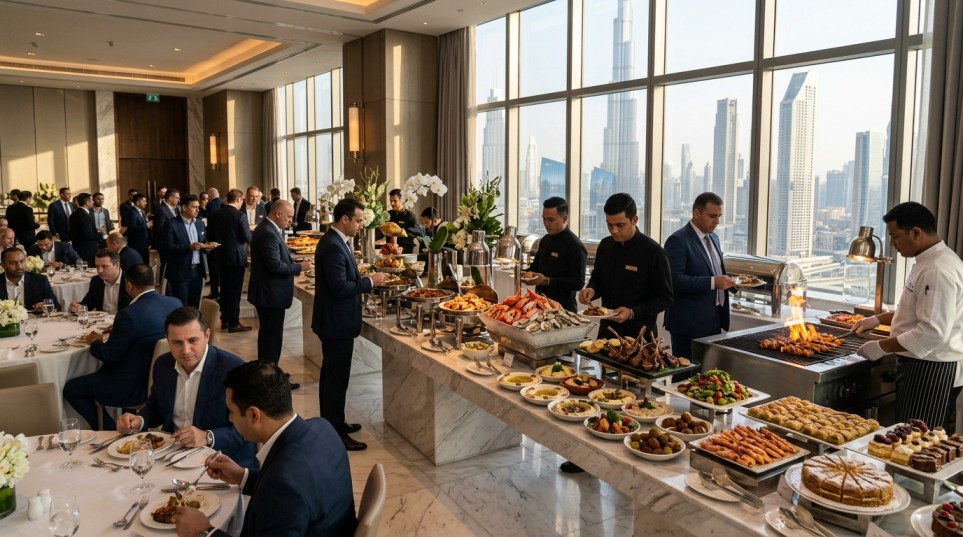
Choosing the best corporate catering company in Dubai requires evaluating 12 specific criteria: halal certification, HACCP food safety compliance, menu customisation for multicultural teams, service style flexibility (buffet, plated, live stations, drop-off), scalability from 20 to 5,000+ guests, per-person pricing transparency, Dubai Municipality licensing, tasting session availability, venue coordination experience, staff-to-guest ratio, contract clarity, and verified client references. Prioritise caterers with 5+ years of corporate event experience in Dubai and a minimum Google rating of 4.5 stars.
Dubai has over 500 registered catering companies. This number makes selecting the right corporate caterer overwhelming for event coordinators, HR professionals, executive assistants, and office managers who carry direct responsibility for making business events successful.
This guide gives you a structured, 12-point evaluation framework that eliminates guesswork. Every criterion is specific to Dubai’s corporate catering landscape — where 200+ nationalities work side by side, halal compliance is mandatory, and summer temperatures exceed 45°C.
Whether you are planning a board meeting for 12 executives in DIFC, a product launch for 200 guests in Business Bay, or an annual conference for 800 attendees at Dubai World Trade Centre, this framework applies to every corporate event type and budget tier.
Why Choosing the Right Corporate Caterer in Dubai Matters
Corporate catering directly impacts three outcomes: employee satisfaction, client impressions, and overall event success. A poor catering choice results in dietary complaints from multicultural teams, food safety incidents that damage your company’s reputation, budget overruns from hidden charges, and professional embarrassment in front of senior leadership or external stakeholders.
Dubai’s corporate environment demands premium hospitality standards because of its international business culture. When your organisation hosts a networking event along Sheikh Zayed Road or a client appreciation dinner in Dubai Marina, food quality shapes how attendees perceive your brand credibility and attention to detail.
The financial risk is real. Corporate event catering in Dubai costs AED 60–350 per person. A 200-guest conference at AED 150 per head represents AED 30,000 committed to a single vendor decision. A wrong choice wastes budget and creates lasting negative impressions that no follow-up communication can fully repair.
Beyond immediate event outcomes, the caterer you select reflects your organisation’s values — whether that means accommodating every dietary need, supporting sustainable food practices, or demonstrating cultural sensitivity during occasions like Ramadan and UAE National Day celebrations.
Key Fact: All catering companies operating in Dubai must maintain active food safety permits issued by Dubai Municipality and undergo regular inspections under Local Order No. 11 of 2003 concerning Public Health and Safety of the Community.
Source: Dubai Municipality Food Safety Department
12 Essential Criteria to Evaluate a Corporate Catering Company in Dubai
These 12 criteria form a complete evaluation framework applicable to every corporate event type — board meetings, annual conferences, team lunches, gala dinners, product launches, corporate Iftars, workshops, and hybrid events combining in-person and remote attendees. Each criterion includes specific questions to ask and red flags to watch for.
Use these criteria sequentially to shortlist, evaluate, and finalise your catering partner with full confidence.
1. Verify Halal Certification and Compliance
Halal certification is non-negotiable for corporate events in Dubai. The caterer must hold valid halal certification from an approved UAE certification body — not simply claim their food is “halal-friendly” without documentation.
Halal compliance extends beyond ingredients. It covers preparation methods, storage protocols, cooking equipment, serving utensils, and supply chain traceability. A properly certified caterer maintains complete separation between halal and non-halal items at every production stage — from raw ingredient receiving through final plating and service delivery.
Ask for three specific things: the certificate number, the issuing authority name, and the certificate expiry date. Cross-verify the certificate directly with the issuing body before entering any contractual discussion.
Red flag: Caterers who say “we use halal ingredients” but cannot produce an official halal certificate from a recognised UAE authority within 24 hours of your request.
Key Fact: The UAE’s halal food sector follows standards set by the Emirates Authority for Standardization and Metrology (ESMA), requiring food establishments to comply with UAE.S GSO 2055-1 for halal food production, handling, storage, and transportation.
Source: Ministry of Industry and Advanced Technology — ESMA
Tip #1: Request a physical or digital copy of the caterer’s halal certificate and cross-check its validity directly with the issuing authority. Complete this verification before any contract discussion begins — it saves time by immediately eliminating non-compliant vendors from your shortlist.
2. Confirm HACCP and Food Safety Certifications
HACCP (Hazard Analysis Critical Control Points) certification confirms the caterer follows systematic, documented food safety protocols covering every stage from ingredient sourcing to guest service delivery.
ISO 22000 is the international standard for food safety management systems. A caterer holding both HACCP and ISO 22000 demonstrates investment in operational excellence that exceeds minimum regulatory requirements — signalling a commitment to long-term quality rather than basic compliance.
Dubai Municipality requires all catering businesses to meet food safety standards. A certified caterer maintains documented procedures for:
- Temperature control during cooking, storage, and transport (hot food above 63°C, cold food below 5°C)
- Allergen identification and cross-contamination prevention protocols
- Staff hygiene practices and regular health screening schedules
- Pest control programmes and kitchen sanitation records
- Full traceability of ingredients from supplier to plate
- Cold chain management with temperature monitoring logs for every transport vehicle
Ask for: their current HACCP certificate, the date of their most recent food safety inspection, food handler training records, and documented corrective action procedures for when standards are breached.
Red flag: Inability to produce valid food safety documentation within 24 hours of your request signals either lapsed certification or poor operational organisation — both disqualifying factors for corporate events.
Key Fact: Dubai Municipality’s Food Safety Department conducts tens of thousands of food safety inspections annually across food establishments in the emirate, covering hygiene compliance, food handling practices, storage conditions, and staff health certifications.
Source: Dubai Municipality Food Safety Department
Tip #2: Confirm the caterer’s HACCP certification specifically covers their off-site catering operations — not only their central kitchen facility. Some certifications apply exclusively to the production premises and do not extend to event-site food handling, transport, or temporary setup locations.
3. Assess Menu Customisation and Multicultural Options
Dubai’s corporate workforce represents over 200 nationalities, with South Asian, Arab, Filipino, European, and East Asian communities forming the largest segments. A corporate food service provider serving this audience must demonstrate genuine multi-cuisine capability backed by trained chefs specialising in each cuisine — not a single-cuisine kitchen attempting unfamiliar dishes.
The caterer must prepare Arabic, Indian, Pakistani, Continental, Asian, Mediterranean, Filipino, Japanese, Chinese, Afghani, and fusion cuisines with equal competence and authentic flavour profiles. Menu customisation must comprehensively cover:
- Dietary accommodations: Vegan, vegetarian, gluten-free, dairy-free, nut-free, low-carb, keto-friendly, pescatarian, organic options
- Religious requirements: Halal (mandatory), kosher (on request for specific events)
- Allergy management: Printed allergen cards at each dish, separate preparation areas, dedicated utensils, staff training on the 14 major food allergens
- Themed menus: Corporate branding integration (company logos on menu cards, colour-coordinated food presentation), cultural celebration themes, seasonal offerings
- Health-focused options: Balanced nutritional profiles, lighter choices for all-day conferences, energy-sustaining meals for workshops
A professional corporate caterer offers minimum 3 cuisine styles per event to accommodate diverse guest preferences without requiring separate vendors. For organisations seeking authentic Indian cuisine catering specifically, verify the caterer employs chefs trained in regional Indian cooking traditions rather than generic interpretations.
Example: A 150-guest corporate conference in Business Bay requires, at minimum: Arabic mains with traditional rice dishes and grilled meats, Indian and Pakistani vegetarian options including paneer, dal, and biryani, Continental selections with grilled proteins and fresh salads, and clearly labelled allergen-free alternatives for guests with specific dietary restrictions. A caterer like Captain Zaiqey covers South Asian, Afghani, Filipino, seafood, and international cuisines from a single kitchen — eliminating multi-vendor coordination complexity.
Tip #3: Request that the caterer provides printed allergen tent cards for every dish at your event, listing all 14 major allergens present or absent. This protects your guests from allergic reactions and your organisation from potential liability claims. Professional caterers produce these as standard practice without additional charge.
4. Evaluate Service Style Options
Different corporate events demand different service models. A versatile catering vendor offers multiple formats and recommends the optimal style based on your specific event type, guest count, venue layout, timeline, and formality level — rather than defaulting to their easiest or most profitable option.
Here is how service styles match corporate event types:
| Service Style | Best For | Guest Count | Formality Level |
|---|---|---|---|
| Buffet service | Conferences, team lunches, workshops, celebrations | 50–500+ | Semi-formal |
| Plated service | Board meetings, gala dinners, investor meetings, client dinners | 20–200 | Formal |
| Live cooking stations | Product launches, networking events, year-end celebrations | 50–300 | Interactive |
| Drop-off/boxed meals | Training sessions, working lunches, daily office catering | 10–100 | Casual |
| Cocktail pass-around | Receptions, launch events, networking evenings | 50–500 | Semi-formal |
| Coffee break stations | Seminars, conferences, half-day workshops | 20–500 | Casual |
| Family-style service | Team dinners, client appreciation, small celebrations | 20–60 | Semi-casual |
| Action/carving stations | Premium buffets, gala additions, awards ceremonies | 100–500 | Premium |
| BBQ and live grill | Outdoor team events, year-end parties, casual networking | 30–200 | Casual-interactive |
For events requiring buffet catering setup, confirm the caterer provides complete station arrangement, replenishment schedules, and clearing service — not just food delivery without ongoing management.
Ask the caterer which service style they recommend for your specific event — and why. Their reasoning reveals whether they genuinely understand corporate catering dynamics, venue flow, and guest experience management — or simply accept orders without strategic input.
Example: A product launch for 120 marketing professionals at a Dubai Marina venue benefits from live cooking stations and BBQ grill setups that create movement, conversation, and visual engagement — while a 15-person board meeting in DIFC requires discreet plated service with silent, anticipatory staff who never interrupt discussion flow.
Red flag: Caterers offering only 1–2 service formats lack the versatility required for corporate clients whose events range from casual team lunches to formal gala dinners throughout the business year.
5. Confirm Capacity and Scalability
Verify the caterer can handle your specific guest count with documented evidence from past events of similar scale — not theoretical claims about what they “can do.”
Ask for: their maximum capacity handled in a single event, their kitchen production output per hour, the total number of trained service staff available on their roster, and 2–3 examples of corporate events matching your anticipated size.
Scalability means the caterer adjusts operations smoothly when guest counts increase or decrease by 15–20% within 48–72 hours of the event. Corporate events rarely have exact final headcounts until the last working days before the occasion — RSVPs arrive late, teams add last-minute attendees, or stakeholders cancel due to schedule conflicts.
For large conferences exceeding 500 guests, confirm the caterer operates industrial kitchen facilities with sufficient cold chain logistics, multiple transport vehicles, and backup equipment inventory. For small executive meetings of 10–20 guests or intimate party catering, verify they deliver identical quality attention without treating your order as low priority compared to larger bookings.
For hybrid events combining in-person attendees with remote participants receiving delivered boxed meals, confirm the caterer handles simultaneous on-site service and individual delivery logistics without quality compromise on either channel.
Tip #4: Include a contractual clause allowing 10–15% guest count adjustment up to 72 hours before the event without financial penalty. Reputable corporate caterers in Dubai accept this as standard practice because fluctuating headcounts are a normal reality in corporate environments.
6. Examine Pricing Transparency and Budget Alignment
Request itemised quotations that break down every cost component separately: food cost per person, service staff charges, equipment rental, transport and delivery fees, setup and breakdown costs, and applicable VAT (5% in the UAE).
Corporate catering pricing tiers in Dubai:
| Tier | Per-Person Range (AED) | What Is Typically Included |
|---|---|---|
| Standard | 60–100 | Buffet setup, basic disposable tableware, delivery, 1-2 cuisine options |
| Premium | 100–175 | Live stations, professional service staff, ceramic tableware, linen, 3+ cuisines |
| Luxury | 175–350+ | Multi-course plated service, dedicated chef, premium décor, beverages, branded elements |
Ask specifically about these commonly hidden extras: minimum order values, overtime charges beyond contracted hours, surplus food policies, corkage fees for beverages, whether equipment rental (chafing dishes, crockery, glassware, linen) is included or billed separately, and transport surcharges for venues outside central Dubai or in neighbouring emirates like Sharjah and Abu Dhabi.
Compare minimum 3 quotations using identical event specifications — same guest count, same service style, same venue, same cuisine requirements — for accurate cost comparison. Quotations based on different specifications produce misleading comparisons that waste your evaluation time.
Red flag: Quotations lacking line-item detail or including vague entries labelled “miscellaneous charges,” “service extras,” or “additional fees TBC” signal intention to inflate costs after your commitment.
Key Fact: The UAE implemented a 5% Value Added Tax (VAT) in January 2018 under Federal Decree-Law No. 8 of 2017. All catering quotations must clearly state whether prices are VAT-inclusive or VAT-exclusive to enable accurate budget planning.
Source: UAE Federal Tax Authority
7. Check Experience and Track Record in Corporate Events
Corporate catering differs fundamentally from wedding or private party catering in 4 critical areas: timing precision (conference sessions run on tight schedules), professional presentation standards (executives expect perfection), dietary diversity requirements (multicultural attendees with varied needs), and service team conduct (staff interact with business clients and senior leadership).
Ask for:
- Number of corporate events catered in the past 12 months
- Client list showing industry variety (finance, technology, healthcare, government, real estate, hospitality, education)
- Case studies or event portfolios with photographs showing setup, food presentation, and service delivery
- Average event size handled regularly
- Types of venues they have operational experience within
Verify years of continuous operation. Caterers with 5+ years in Dubai have navigated regulatory changes, peak-season demand surges (October through March), Ramadan-specific requirements (Iftar and Suhoor services), UAE National Day celebrations, multiple venue protocols, and summer logistics challenges that test operational resilience.
Request references from 2–3 corporate clients of similar event scale. Contact them directly and ask these specific questions:
- Was the food delivered on time and at the correct serving temperature?
- Did the caterer handle any last-minute headcount or menu changes professionally?
- How was communication quality in the weeks and days leading up to the event?
- Would you hire them again for your next corporate function without hesitation?
Red flag: A portfolio showing exclusively social events (weddings, birthday parties, baby showers) with zero documented corporate event experience. Social catering and corporate catering require fundamentally different operational disciplines, timing precision, and service team training.
Tip #5: Ask reference clients one specific question: “Did anything go wrong, and how did the caterer handle it?” Problem resolution ability reveals far more about a caterer’s reliability and professionalism than a curated list of perfect events ever could. Every caterer faces unexpected challenges — what matters is their response quality.
8. Verify Dubai Municipality Licensing and Legal Compliance
Every catering company operating in Dubai must hold a valid trade licence issued by the Department of Economy and Tourism (DET). The licence must specifically list “catering services” as an approved commercial activity — general food trading licences do not authorise event catering operations.
Additional mandatory requirements include:
- Dubai Municipality food safety permit (renewed annually after successful inspection)
- Individual health cards for all food handling staff (renewed annually through medical screening)
- Vehicle permits for each food transport vehicle in the fleet
- Approved kitchen facility inspection certificate
- Civil defence approval for kitchen premises
- Staff food safety training certificates (Level 2 minimum for food handlers, Level 3 for kitchen supervisors)
Free zone companies (DMCC, DIFC, Dubai Internet City, Media City, JLT) may face additional or different licensing requirements when serving events outside their designated zone boundaries. Confirm your caterer holds the proper permits specifically for your venue location — not just for their registered office address.
Red flag: Caterers operating without proper licensing expose your organisation to legal liability if a food safety incident occurs at your event. Your company may face regulatory scrutiny for engaging an unlicensed food service provider — regardless of whether your organisation knew about the licence status.
Key Fact: The Department of Economy and Tourism (DET) in Dubai issues and regulates all commercial licences for businesses operating within the emirate, including catering service providers. Valid licences are verifiable through their official registry system.
Source: Department of Economy and Tourism Dubai
9. Schedule a Tasting Session
A tasting session is the single most reliable method to evaluate food quality before committing your budget. No amount of marketing material, website photography, or social media content substitutes for tasting the actual food your guests will receive.
Professional corporate caterers in Dubai offer tastings as standard practice — typically complimentary for events exceeding 100 guests or at a nominal fee of AED 200–500 for smaller bookings (often credited to your final invoice upon confirmed booking).
During the tasting, evaluate these 6 critical factors:
- Flavour balance — Is the seasoning consistent, appropriate, and authentic to each cuisine style?
- Ingredient freshness — Are vegetables crisp, proteins tender and properly cooked, grains perfectly textured?
- Visual presentation — Does the plating and food arrangement standard meet corporate event expectations?
- Temperature accuracy — Hot food served genuinely hot (above 63°C), cold food served properly cold (below 5°C)
- Portion sizing — Appropriate for a corporate setting (satisfying without creating excessive food waste)
- Modification responsiveness — Does the caterer accept your feedback gracefully and adjust recipes willingly?
Bring 2–3 decision-makers to the tasting for varied perspectives on flavour preferences, presentation standards, and portion expectations. Document your observations immediately — memory of subtle flavour differences fades quickly when comparing multiple caterers over several days.
Use the tasting to simultaneously assess the caterer’s communication style, punctuality (did they start on time?), venue cleanliness, and overall professionalism while being observed.
Red flag: Caterers who refuse tastings entirely, repeatedly delay scheduling beyond 2 weeks, or charge excessive non-refundable fees. These behaviours signal either food quality problems they prefer you not discover or operational disorganisation that will worsen under event-day pressure.
Tip #6: Schedule your tasting on a day when the caterer is simultaneously handling another event or managing a busy service period. This reveals their actual operational quality under real-world pressure — not a staged showcase prepared exclusively for your visit with their best chef, premium ingredients, and extra preparation time.
10. Assess Staff Professionalism and Service Ratio
Catering staff represent your organisation throughout the event. Their appearance, conduct, communication ability, and efficiency reflect directly on your company in front of clients, executives, partners, investors, and employees.
Industry-standard staff-to-guest ratios for corporate events in Dubai:
| Service Style | Recommended Staff Ratio | Additional Notes |
|---|---|---|
| Buffet service | 1 server per 25–30 guests | Plus dedicated replenishment and clearing staff |
| Plated service | 1 server per 10–12 guests | Synchronised course delivery timing required |
| Cocktail pass-around | 1 server per 15–20 guests | Continuous circulation and replenishment pattern |
| Live cooking stations | 1 chef + 1 attendant per station | Chef prepares food, attendant manages guest queue |
| Coffee break service | 1 attendant per 40–50 guests | Focus on timely replenishment and station cleanliness |
| Carving/action stations | 1 skilled chef per station | Guest interaction, presentation skills required |
| BBQ/grill stations | 1 grill chef + 1 service attendant | Outdoor events, interactive cooking display |
Evaluate these service quality indicators before booking:
- Uniforms: Clean, pressed, professional appearance matching your event formality level
- Grooming standards: Neat, hygienic, presentable for corporate business environment
- Language proficiency: English and Arabic fluency (minimum requirement in Dubai’s multinational corporate setting)
- Food knowledge: Ability to explain each dish, its ingredients, preparation method, and allergen content to curious guests
- Service etiquette: Discreet, anticipatory, non-intrusive, aware of corporate meeting protocols and business conversation sensitivity
Ask whether the caterer uses in-house trained staff or outsourced temporary workers hired per event. In-house teams deliver consistent quality because they know the caterer’s operational standards, presentation systems, and complete menu details from daily practice — not from a briefing 30 minutes before your event begins.
Red flag: Caterers who cannot confirm exact staff numbers, uniform specifications, or language abilities at minimum 7 days before your event demonstrate insufficient planning capability for corporate functions where details matter.
11. Evaluate Venue Coordination and Logistics Capability
Experienced corporate caterers coordinate seamlessly with venue management on kitchen access timing, loading dock schedules, freight elevator bookings, setup timelines, power supply requirements, equipment size restrictions, waste disposal protocols, and post-event breakdown procedures.
Many Dubai venues maintain approved vendor lists or preferred caterer partnerships. These include:
- Dubai World Trade Centre (DWTC) — strict vendor registration and safety protocols
- Major 5-star hotels (Atlantis, Jumeirah Group, Address Hotels, Marriott, Hilton properties)
- Free zone event spaces (DIFC Gate Village, DMCC conference facilities, Dubai Internet City)
- Purpose-built conference centres and exhibition halls
- Tower event spaces and corporate lounges along Sheikh Zayed Road, in JLT, Business Bay, and Downtown Dubai
Confirm your caterer is listed on the venue’s approved vendor registry — or can obtain formal approval before your event date. Some venues require 2–4 weeks advance notice for new vendor approval processing, including kitchen inspection visits and insurance verification.
For outdoor corporate events during Dubai’s summer months (June through September), verify the caterer operates climate-controlled transport vehicles with real-time temperature monitoring systems and follows strict outdoor food safety protocols. Essential requirements include insulated thermal packaging for individual dish transport, rapid setup procedures minimising food exposure to ambient heat, shaded service stations with cooling equipment, and contingency plans for sandstorms or unexpected weather changes.
Corporate events in locations along Sheikh Zayed Road, in Business Bay, JLT, Dubai Marina, or Downtown Dubai require caterers familiar with specific building access protocols, freight elevator booking systems, parking restrictions, and security clearance procedures that vary significantly between tower managements and can delay setup if not pre-arranged.
Key Fact: Food safety standards require hot food to be maintained above 63°C and cold food below 5°C during all stages of transport and service. Bacterial growth accelerates rapidly in the temperature “danger zone” between 5°C and 63°C — potentially doubling harmful bacteria populations every 20 minutes in uncontrolled environments, which is particularly relevant during Dubai’s summer months.
Source: Dubai Municipality Food Safety Department
Ask for: a detailed logistics timeline specific to your venue, documented backup plans for equipment failures or vehicle breakdowns, contingency protocols for staff illness, and the name and direct mobile contact number of your assigned coordination person.
12. Review Contract Terms and Cancellation Policies
A professional catering contract documents every aspect of the service agreement in writing. Verbal promises without written confirmation carry zero enforceable value when problems arise on event day — regardless of how sincere they sounded during the sales meeting.
Essential contract elements to verify before signing:
- Menu details: Complete dish list with exact quantities per dish, substitution alternatives if ingredients are unavailable, and allergen documentation for every item
- Pricing: Confirmed per-person rate, total cost with itemised breakdown, VAT treatment (inclusive or exclusive), and conditions under which the price may change
- Staff: Exact headcount committed, service hours (start to end), overtime rates per additional hour, and supervisor identification
- Equipment: Full list of items included versus items billed separately (chafing dishes, tableware, glassware, linen, serving utensils, buffet risers, station setups)
- Timeline: Setup start time, service commencement, service duration, breakdown start, venue clearance deadline
- Guest count deadline: Final headcount confirmation date (typically 72 hours before event)
- Payment schedule: Deposit percentage (industry standard 30–50%), interim payment if applicable, balance due date, accepted payment methods
- Cancellation terms: Refund percentages clearly stated by timeframe (14+ days: 80–100% refund, 7–14 days: 50% refund, under 7 days: no refund — typical Dubai industry structure)
- Force majeure: Emergency clause covering unforeseen circumstances (pandemic restrictions, severe weather events, government-mandated closures, venue cancellations)
- Liability and insurance: Coverage for food safety incidents, property damage at venue, staff injury during setup/service, guest allergic reactions
- Surplus food: Policy for leftover food — packaged for client collection, donated to registered food banks, composted through approved programmes, or disposed according to municipality guidelines
- Food waste management: Responsible disposal options and reporting capability for organisations with ESG (Environmental, Social, and Governance) reporting requirements
- Post-event process: Feedback mechanism, debrief meeting schedule, or satisfaction survey delivered within 48 hours of event completion
Red flag: Contracts shorter than 2 pages, or caterers who resist putting verbal commitments into written documentation. The principle is straightforward: if they refuse to write it down, they do not intend to deliver it consistently.
Corporate Event Types and Their Specific Catering Requirements
Different corporate events demand fundamentally different catering approaches. Identifying your event type before contacting caterers helps you filter options immediately, communicate requirements clearly during initial enquiries, and evaluate proposals against the correct benchmarks.
| Event Type | Guest Count | Ideal Service Style | Menu Focus | Critical Requirement |
|---|---|---|---|---|
| Board meeting | 8–20 | Plated or family-style | Premium, 2–3 courses | Discreet, silent service |
| Corporate conference | 100–1,000+ | Buffet + coffee breaks | High-volume, diverse cuisines | Timing precision between sessions |
| Team lunch | 20–80 | Drop-off or casual buffet | Casual, varied options | Speed with minimal workplace disruption |
| Product launch | 50–300 | Cocktail + live stations | Creative, branded presentation | Visual impact, social media appeal, branded elements |
| Gala dinner | 100–500 | Multi-course plated | Premium, 4–5 courses | Elegant service choreography |
| Corporate Iftar | 50–500+ | Arabic buffet with live stations | Traditional Arabic + international | Cultural sensitivity, dates, Arabic coffee, Ramadan timing |
| Suhoor gathering | 30–200 | Buffet with Arabic focus | Traditional pre-dawn meal items | Late-night timing, cultural authenticity |
| Client appreciation dinner | 20–100 | Plated or family-style | High-end, personalised | Impeccable quality, zero errors tolerated |
| Workshop/Training | 20–50 | Boxed meals or light buffet | Healthy, energising | Quick service, no session distraction |
| Year-end celebration | 100–500 | Buffet + live stations + dessert bar | Celebratory, varied, indulgent | Fun presentation, interactive elements |
| Investor meeting | 10–30 | Premium plated service | International fine dining | Absolute precision, premium ingredients |
| UAE National Day celebration | 100–500+ | Buffet + action stations | Arabic-themed, celebratory | Patriotic décor integration, cultural authenticity |
| Hybrid event (in-person + remote) | 30–200 on-site | Plated on-site + boxed delivery | Premium, photogenic for video | Simultaneous on-site and delivery coordination |
| Outdoor team building | 30–150 | BBQ live grill + buffet | Casual, interactive grilling | Heat management, outdoor food safety protocols |
For product launches and brand events, ask whether the caterer offers branded catering elements — company logos on napkins, custom-printed menu cards, colour-coordinated food presentations, or packaging designed to match your corporate identity guidelines and social media aesthetic.
For more inspiration on creative event catering formats suited to Dubai’s diverse food culture, explore these catering ideas for Dubai events.
Red Flags When Choosing a Corporate Caterer in Dubai
These 10 warning signs indicate an unreliable or unprofessional catering company. Encountering 2 or more of these signals during your evaluation process is sufficient reason to remove the vendor from your shortlist entirely:
- No valid trade licence or food safety permit — Operating outside legal requirements, exposing your organisation to regulatory liability and food safety risk for every guest
- Refuses or delays tasting sessions beyond 2 weeks — Concealing food quality problems they cannot resolve under real production conditions
- Vague or non-itemised quotations — Planning to add undisclosed charges after commitment, making budget control impossible and approvals embarrassing
- No dedicated event coordinator assigned to your booking — Your event will be managed reactively rather than proactively, increasing the probability of coordination failures on event day
- Cannot provide 3+ corporate client references with direct contact details — Lacks relevant experience handling professional events with the timing precision and service standards corporate functions require
- Uses exclusively outsourced temporary staff for every event — Inconsistent service quality because workers are unfamiliar with the caterer’s operational standards, menu details, and presentation protocols
- No documented allergen management process or cross-contamination prevention protocol — Creates serious health liability for your guests with allergies and potential legal exposure for your organisation
- Pressures for 100% upfront payment before the event — Signals financial instability, cash flow problems, or intention to under-deliver once full payment is secured with no leverage remaining
- Response time exceeds 48 hours consistently during the enquiry phase — Communication quality will only deteriorate further under event-day pressure when real-time decisions and adjustments are needed
- No contingency plan or backup procedures for emergencies — Unprepared for equipment failure, staff illness, vehicle breakdown, supply chain disruptions, or sudden guest count changes that occur regularly in corporate event environments
Questions to Ask a Corporate Catering Company Before Booking
Use these 15 questions during vendor meetings, site visits, or phone calls to systematically reveal competence, reliability, and genuine professionalism. Document every answer in writing and compare responses across your shortlisted vendors:
- Are you HACCP certified specifically for off-site catering operations, not only your central kitchen?
- Can you provide your current Dubai Municipality food safety permit number for independent verification?
- How many corporate events do you cater per month on average during peak and off-peak seasons?
- What is your staff-to-guest ratio for buffet service? For plated service? For live stations?
- How do you manage food allergies and prevent cross-contamination in both your kitchen and at event sites?
- What happens operationally if our guest count changes by 15–20% within 48 hours of the event?
- Do you use in-house trained staff or outsourced temporary workers for event service?
- Can you provide direct contact details of 3 corporate clients who hosted events of similar size for reference calls?
- What specifically is included in the per-person rate and what costs are billed additionally?
- Do you operate climate-controlled vehicles with temperature monitoring systems for food transport?
- Have you worked at our specific venue before? Are you currently on their approved vendor list?
- What is your cancellation and refund policy at 14 days, 7 days, and 48 hours before the event?
- When is the absolute final deadline for menu selection confirmation and guest count finalisation?
- Do you carry comprehensive liability insurance specifically covering food safety incidents at catering events?
- Can we schedule a tasting session within the next 2 weeks at your facility?
Professional caterers provide clear, confident, documented responses to all 15 questions without hesitation, vague deflections, or promises to “get back to you later.” Evasive answers at the enquiry stage predict evasive behaviour at the execution stage.
Which catering service in Dubai meets high-quality standards?
Captain Zaiqey fulfils the complete evaluation framework outlined in this guide. Here is how they meet each critical selection criterion for corporate events in Dubai:
- Halal certified: 100% halal kitchen operations with certified ingredients and documented preparation protocols throughout the entire supply chain
- Food safety compliant: Maintains food safety standards aligned with Dubai Municipality requirements, with trained food handling staff and documented hygiene procedures at every production stage
- Multi-cuisine capability: Specialises in Pakistani, Indian, Afghani, Mughlai, Filipino, seafood, Italian, and international cuisines — serving Dubai’s multicultural corporate workforce with authentic flavour profiles from each culinary tradition
- Service style versatility: Offers buffet service, boxed meals, live cooking stations including BBQ grill, family-style, and plated service for events across all formality levels
- Capacity and scalability: Handles events from 20 to 500+ guests with consistent quality, dedicated staff teams, and scalable kitchen operations that adjust to last-minute headcount changes
- Transparent pricing: Corporate packages with clear itemisation — no hidden charges, no vague “miscellaneous” line items, no post-booking surprises
- Corporate experience: Dedicated corporate catering division serving offices, conferences, meetings, team lunches, and business celebrations across Dubai, Sharjah, and Abu Dhabi
- Central location: Based in Al Karama, Dubai — central positioning enabling efficient delivery across the entire emirate with minimal transport time to major business districts including DIFC, Business Bay, Sheikh Zayed Road, JLT, and Dubai Marina
- Proven process: Structured consultation-to-execution process from initial enquiry through menu design, tasting session, logistics coordination, to flawless event-day delivery
- Client rating: Verified client testimonials reflecting consistent food quality, punctuality, and service reliability across hundreds of events
- Delivery guarantee: On-time delivery commitment for all corporate and office catering orders with proactive communication throughout the planning and execution process
- Post-event support: Feedback collection and continuous improvement based on client input after every event served
Whether you need outdoor event catering for a team building day, catering for an intimate executive gathering, or a full-scale conference buffet for 500 guests, Captain Zaiqey’s dedicated team manages every detail from your first enquiry through post-event cleanup.
For corporate event enquiries, explore Captain Zaiqey’s complete catering menu or contact the team directly for a customised quotation.
Corporate Catering Selection Checklist
Use this three-phase checklist during your vendor evaluation process to ensure no critical factor is overlooked:
Phase 1 — Before Shortlisting (Eliminate Unqualified Vendors):
- ☐ Verified valid trade licence with “catering services” listed as approved activity
- ☐ Confirmed active Dubai Municipality food safety permit with current validity
- ☐ Confirmed halal certification with official documentation and valid expiry date
- ☐ Confirmed HACCP or ISO 22000 certification specifically covering off-site catering operations
- ☐ Reviewed Google ratings (minimum 4.5 stars with 50+ verified reviews)
- ☐ Confirmed corporate event experience documented in portfolio (not exclusively social/wedding events)
- ☐ Verified service area covers your specific venue location
Phase 2 — During Active Evaluation (Compare Shortlisted Options):
- ☐ Requested and received fully itemised quotation with all costs individually disclosed
- ☐ Compared minimum 3 caterers using identical event specifications for accurate benchmarking
- ☐ Attended tasting session and evaluated food quality across all 6 criteria documented in this guide
- ☐ Confirmed staff-to-guest ratio matches your chosen service style requirements
- ☐ Verified venue coordination experience or obtained written venue approval confirmation
- ☐ Contacted 2–3 corporate client references directly by phone and documented responses
Phase 3 — Before Signing Contract (Protect Your Organisation):
- ☐ All menu items, quantities, and substitution alternatives documented in written contract
- ☐ Cancellation and refund terms clearly stated with specific percentage-by-timeframe breakdown
- ☐ Guest count adjustment deadline confirmed (standard: 72 hours before event)
- ☐ Payment schedule and deposit amount agreed upon (standard: 30–50% deposit)
- ☐ Comprehensive liability insurance confirmed and certificate copy provided for your records
- ☐ Dedicated event coordinator assigned by name with direct mobile contact number
- ☐ Post-event feedback mechanism agreed (debrief meeting or satisfaction survey within 48 hours)
- ☐ Food waste management and surplus food policy clearly documented
- ☐ Force majeure clause included covering unforeseen circumstances
When evaluating caterers who also handle wedding catering and birthday party catering alongside corporate events, this dual capability often indicates a larger operation with diverse staff experience — but always verify their corporate-specific track record separately.
Frequently Asked Questions
How much does corporate catering cost in Dubai?
Corporate catering in Dubai costs AED 60–350+ per person depending on service style, menu complexity, cuisine variety, and event formality level. Standard buffet packages range from AED 60–100 per person including 1–2 cuisine options and basic setup. Premium service with live cooking stations and professional staff costs AED 100–175 per person. Luxury multi-course gala dinners with beverages, premium tableware, and dedicated chefs start at AED 175 and exceed AED 350 for ultra-premium experiences.
How far in advance should I book a corporate caterer in Dubai?
Book a corporate caterer minimum 2–4 weeks in advance for standard office events, team lunches, and small meetings. Large conferences or gala dinners exceeding 200 guests require 6–8 weeks lead time for menu development, tasting sessions, and staffing arrangements. During Dubai’s peak corporate season (October through March) and Ramadan for Iftar events, book 4–6 weeks ahead to secure preferred caterers and ensure full menu availability.
What certifications should a Dubai catering company have?
A legitimate Dubai catering company must hold 5 essential credentials: a valid trade licence from the Department of Economy and Tourism listing catering as an approved activity, a Dubai Municipality food safety permit renewed annually after inspection, HACCP certification for food safety management covering off-site operations, halal certification from an approved UAE-recognised body, and current health cards for all food handling staff renewed annually through medical screening.
Can corporate caterers in Dubai accommodate dietary restrictions?
Professional corporate caterers in Dubai accommodate halal, vegetarian, vegan, gluten-free, dairy-free, nut-free, pescatarian, keto-friendly, and other specific dietary requirements. Request the caterer’s documented allergen management protocol, ask specifically about cross-contamination prevention measures in both their production kitchen and at event service sites, and confirm they provide visible ingredient and allergen labelling at every serving station for guest safety and your organisation’s liability protection.
Do catering companies provide equipment and service staff?
Full-service corporate caterers provide all necessary equipment — chafing dishes, ceramic tableware, glassware, linen, serving utensils, buffet risers, station setups, and beverage dispensers — along with trained, uniformed service staff. Confirm whether these items are included in the per-person rate or charged as separate line items. Some caterers bill additionally for premium tableware upgrades, specialised equipment (live station setups, carving stations, BBQ grills), or extended service hours beyond the contracted event duration.
What is the difference between buffet and plated service for corporate events?
Buffet service presents multiple dishes in a self-service format with guests moving through food stations at their own pace, suitable for 50–500+ guests at semi-formal corporate events like conferences, workshops, and team celebrations. Plated service delivers individually portioned courses to seated guests by trained waitstaff in precisely synchronised sequence, ideal for formal events of 20–200 attendees such as board meetings, client dinners, investor meetings, and award ceremonies. Buffet catering costs AED 60–120 per person in Dubai, while plated service ranges from AED 120–250+ per person depending on menu complexity, course count, and ingredient quality tier.
Selecting the right corporate catering company in Dubai protects your professional reputation, satisfies diverse guest expectations across 200+ nationalities, and ensures your business event achieves its intended outcome — whether that is closing a deal, celebrating a milestone, launching a product, or strengthening team relationships. Use this 12-point evaluation framework to assess every caterer you consider, and partner with the provider that consistently demonstrates these standards through documented evidence, verified references, and transparent operations — not marketing promises alone.
This guide is based on real-world corporate catering experience serving events across Dubai, Sharjah, and Abu Dhabi — from intimate 10-person executive meetings to large-scale conferences and business celebrations.
For a broader comparison of established catering providers in the emirate, read our detailed guide on the best catering companies in Dubai. To learn more about Captain Zaiqey and our commitment to quality corporate catering, visit our story page.