
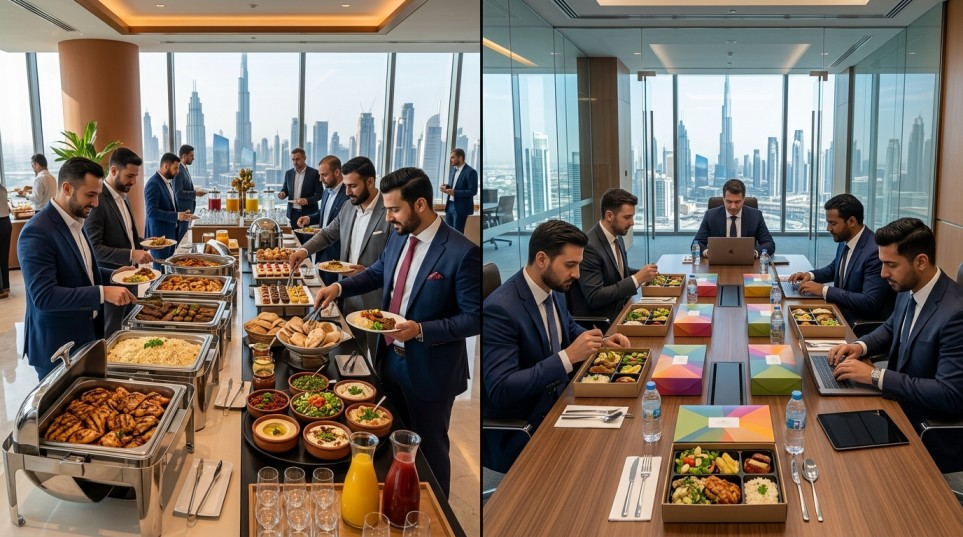
This guide is written for office managers, HR professionals, and executive assistants planning corporate events across the UAE. It is based on Dubai-specific catering logistics, local AED pricing, Dubai Municipality food safety requirements, and the dietary realities of managing multicultural teams in the Emirates.
Buffet catering works best for office celebrations, networking events, and gatherings with 25+ attendees where variety and social interaction matter most. Boxed meals are the stronger choice for working lunches, training sessions, and meetings with tight schedules — especially during Dubai’s summer months when sealed packaging maintains food safety in 45°C+ heat.
Neither format is universally better. The right choice depends on 5 factors: your event type, team size, available office space, dietary diversity across your team, and the time of year.
Dubai offices face unique challenges that generic catering guides ignore completely. Your workforce includes colleagues from over 200 nationalities. Your office likely sits on the 25th floor of a tower in Business Bay or DIFC. Summer temperatures exceed 45°C for 4 consecutive months. These realities change the catering decision entirely.
This comparison gives you everything you need to choose confidently — with real AED pricing, food safety protocols, delivery logistics for high-rise offices, and a clear decision framework you can act on immediately.
Quick Comparison: Buffet vs Boxed Meals at a Glance
| Factor | Buffet | Boxed Meals |
|---|---|---|
| Cost per person (AED) | 55–150 | 35–95 |
| Ideal team size | 25–500+ | 5–100 |
| Setup time | 30–60 minutes | 5–10 minutes |
| Space required | 15–30 sqm open area | Minimal (desk-compatible) |
| Food waste | 15–25% of prepared food | 5–10% of prepared food |
| Dietary control | Moderate (station-based) | High (individually labelled) |
| Social interaction | High | Low to moderate |
| Food safety in heat | Requires hot/cold holding equipment | Sealed insulated packaging |
| Best suited for | Celebrations, networking, conferences | Training, short meetings, working lunches |
What Is Buffet Catering for Office Events?
Buffet catering is a self-service communal dining format where food is displayed across shared stations and attendees serve themselves from a variety of dishes. It is the most established corporate catering format in the UAE for events exceeding 30 guests.
A typical corporate buffet setup in a Dubai office includes:
- Chafing dishes maintaining hot food above 60°C
- A cold mezze and salad station
- A main course station with 2–3 protein options
- A carbohydrate station (rice, Arabic bread, pasta)
- A dessert counter with fresh fruit and sweets
- A beverage station (water, fresh juice, Arabic coffee, tea)
Dubai caterers offer 3 primary buffet layout styles:
- Straight-line layout — dishes arranged in sequence along one table
- U-shaped station — food arranged around three sides for better flow
- Island setup — central table accessible from all directions, reducing queue times
For groups exceeding 100 attendees, parallel food counters — two identical serving lines running side by side — reduce queue times significantly, often by half compared to a single-line arrangement.
What Are Boxed Meals for Office Catering?
Boxed meals are individually portioned, pre-packaged meals delivered in sealed containers. Each box contains a complete meal — typically a main course, a side salad or grain, a small dessert, disposable cutlery, a napkin, and sometimes a beverage.
Each container is labelled with the recipient’s name and dietary category. Distribution is simple: hand them out, and everyone eats. No setup, no serving staff, no equipment.
In Dubai, corporate boxed meals are available in 3 common tiers:
- Standard tier (AED 35–55): Main course + side + water
- Premium tier (AED 55–95): High-quality protein, fresh salad, artisan bread, dessert, juice
- Healthy/wellness tier (AED 45–75): Calorie-conscious, balanced macronutrients, nutritional information on the label
Individually packaged meals have become the preferred format for many Dubai office managers since 2020. The heightened hygiene consciousness that emerged during that period made sealed, single-serve meals a practical default — and the preference has remained strong across the corporate catering market.
Advantages of Buffet Catering for Dubai Offices
Variety Across Cuisines for Multicultural Teams
Dubai offices are unlike offices anywhere else in the world. The UAE is home to over 200 nationalities, and your team likely reflects that diversity — colleagues from South Asia, the Middle East, Europe, East Asia, and Africa sitting on the same floor.
A single buffet spread can include an Arabic mezze and grills station alongside a South Asian curry counter and a Continental pasta or salad bar — all served simultaneously. This accommodates diverse palates without requiring advance meal selection from every individual.
Example: A 60-person technology team in DIFC with employees from 14 nationalities is served with a 3-station buffet — Arabic, South Asian, and International. Each person finds familiar dishes without any pre-ordering complexity. The caterer prepares one unified spread rather than 60 individual customised boxes.
This approach works because buffets offer choice at the point of consumption rather than requiring decisions days in advance.
Encourages Networking and Team Interaction
Buffets create movement. People leave their desks, walk to the food stations, queue together, share tables, and start conversations they would never initiate over email.
This social dynamic makes buffets ideal for:
- Cross-department interaction in large organisations
- Team bonding after completing a major project
- Welcoming new joiners through informal group dining
- Celebrating company milestones, promotions, and cultural festivals
- Building relationships between teams that rarely collaborate
The shared dining experience generates social energy that individual desk-based eating cannot replicate. For companies investing in return-to-office culture, a well-planned communal lunch gives employees a tangible reason to be present — creating connection that remote work cannot offer.
Visual Presentation and Professional Impression
A well-arranged buffet with live cooking stations — a pasta counter, a carving station, a made-to-order stir-fry wok — creates a premium atmosphere that communicates investment and care.
This matters when your audience includes:
- Clients visiting your office for a business lunch
- Board members attending quarterly reviews
- External partners or investors at product launches
- Government stakeholders at formal corporate events
Island setups and themed stations with signature dishes elevate the dining experience beyond a simple meal. The visual spread communicates generosity and professionalism — values deeply aligned with Emirati hospitality culture, where abundance in food presentation reflects respect for guests.
Cost-Efficient for Large Groups
Per-person cost decreases as headcount increases with buffet catering. The caterer prepares food in bulk, reducing ingredient costs, preparation complexity, and per-unit packaging.
For groups of 50+ attendees, standard corporate buffets in Dubai cost AED 55–85 per person. At this scale, buffet catering is typically 20–35% less expensive per head than ordering equivalent-quality boxed meals individually.
The cost efficiency comes from:
- Bulk ingredient purchasing by the caterer
- Shared preparation (one large biryani pot vs. 50 individual portions)
- No individual packaging or labelling costs
- Fewer delivery trips (food in large containers vs. individual boxes)
Supports Return-to-Office Culture
Quality catering has become a strategic tool for encouraging office attendance across Dubai’s commercial districts. Companies in DIFC, Business Bay, and Dubai Media City report that regular team lunches improve in-office presence by creating a sense of community and belonging.
A buffet lunch every Thursday or Friday — with seasonal menus rotating weekly — gives hybrid teams a recurring reason to gather physically. This small investment in food translates to stronger team cohesion and improved collaboration.
Advantages of Boxed Meals for Dubai Offices
Superior Food Safety in Dubai’s Extreme Heat
This is the single biggest advantage of boxed meals in the Dubai context — and the factor that generic global catering guides ignore entirely.
Dubai’s summer temperatures exceed 45°C from June to September. The temperature danger zone for bacterial growth is between 5°C and 60°C. Food left exposed in this range for more than 2 hours becomes unsafe to consume.
During a summer delivery from a kitchen in Al Quoz to an office on the 35th floor of a Business Bay tower, open food containers can enter the danger zone within 20–30 minutes if unprotected — accounting for loading, transit in traffic, building access, service elevator wait, and floor delivery.
Boxed meals eliminate this risk. Sealed, insulated packaging maintains safe internal temperatures for 2–3 hours after packing. There is no open-air exposure during transit, no communal serving utensils spreading contact, and no extended setup time in a warm lobby or corridor.
Key Fact: Dubai Municipality requires all commercial food establishments and caterers to comply with HACCP (Hazard Analysis Critical Control Points) food safety protocols. Temperature-controlled delivery and proper food handling are mandatory compliance requirements for all licensed catering operations in the emirate.
Source: Dubai Municipality — Food Safety Department
Individual Dietary Labelling for Diverse Teams
In a typical Dubai office of 40 people, you might encounter 6–8 different dietary requirements in a single lunch order:
- Halal — mandatory for all meat served in the UAE
- Vegetarian — common among South Asian and European employees
- Vegan — growing preference across all demographics
- Gluten-free — medical (coeliac) and preference-based
- Nut-free — potentially life-threatening allergy
- Dairy-free / Lactose-free — intolerance and vegan overlap
- Low-carb / Keto — health-conscious professionals
- Jain vegetarian — no root vegetables, specific to the Indian Jain community
- Pescatarian — preference-based
With boxed meals, each container is sealed, labelled, and separated. Ahmad receives his halal grilled chicken box. Priya receives her Jain vegetarian meal without onion or garlic. James receives his gluten-free option prepared on separate surfaces. There is zero guesswork, zero cross-contamination risk, and zero awkward moments at a shared serving station.
This level of dietary precision is nearly impossible to guarantee with a buffet format — where shared serving spoons, adjacent dishes, and steam from neighbouring chafing dishes create confusion and allergen risk.
Minimal Space and Zero Setup Requirements
Most Dubai offices in Business Bay, JLT, DIFC, Dubai Media City, Dubai Internet City, and Dubai Knowledge Park are located in high-rise commercial towers. The typical office has a compact pantry, a small breakroom — and limited open floor area that is already occupied by desks and meeting rooms.
A buffet requires 15–30 sqm of clear floor space for tables, chafing dishes, serving lines, and movement flow. Many Dubai offices simply do not have this space available without rearranging furniture or booking a separate floor.
Boxed meals require nothing. They arrive in stacked insulated bags, get distributed by the office coordinator in 5–10 minutes, and employees eat at their desks, in meeting rooms, or in any available space. No tables, no equipment, no rearranging, no cleanup coordination.
Time-Efficient for Working Lunches and Training Days
When your agenda is packed and lunch is squeezed between two sessions, every minute matters.
| Time Element | Buffet | Boxed Meals |
|---|---|---|
| Caterer setup | 30–60 minutes | 0 minutes |
| Queue and serving time | 10–20 minutes per person | 0 minutes (distributed directly) |
| Distribution to team | N/A | 5–10 minutes total |
| Cleanup and breakdown | 15–30 minutes | Individual disposal (2 minutes) |
| Total time impact on schedule | 55–110 minutes | 5–12 minutes |
For training sessions, workshops, lunch-and-learn events, and back-to-back meeting schedules, boxed meals allow participants to eat while the session continues. Laptops stay open, presentations keep running, and the agenda stays on track.
Precise Portion Control and Lower Food Waste
Each person receives exactly one complete meal. There is no over-serving, no untouched platters sitting on a buffet table, and no trays of food that go to waste because the caterer prepared for 50 but only 38 people attended.
Boxed meals generate 50–70% less food waste than buffets. The portion-based ordering model means 1 box equals 1 person — simple mathematics that eliminates surplus.
Key Fact: The GCC catering services market continues to grow, driven by increasing corporate catering demand in commercial hubs including Dubai. The market’s expansion reflects rising corporate investment in employee dining, workplace wellness, and professional event services across the Gulf region.
Source: MarkNtel Advisors — GCC Catering Services Market Report
Challenges of Each Format in Dubai
No catering format is perfect. Understanding the limitations helps you plan around them.
Buffet Challenges in Dubai Offices
- Space requirement: 15–30 sqm of open floor space is needed — unavailable in many Dubai office towers where every square metre is allocated to workstations
- Food safety risk in summer: Open food exposure during June–September requires continuous hot holding above 60°C and cold holding below 5°C — if equipment fails during transit or setup, the entire spread is compromised
- Queue frustration: 10–20 minutes of waiting frustrates employees with 30-minute lunch breaks, especially in fast-paced environments
- Higher food waste: 15–25% of prepared food typically goes uneaten, particularly less popular dishes or items placed at the end of the serving line
- Building coordination complexity: Service elevator booking, security clearance for 2–4 serving staff, and loading dock access must all be arranged 48+ hours in advance with building management
- Serving staff required: A ratio of 1 service staff member per 25–30 guests is recommended for professional execution — this adds cost and coordination
Boxed Meal Challenges in Dubai Offices
- Limited variety per person: Each individual receives 1 main course + 2–3 sides, compared to 8–15 dishes available at a buffet spread
- Higher packaging waste: Individual containers, sealed lids, cutlery packets, and napkins generate more disposable material per person
- Reduced social interaction: Employees eating alone at their desks miss the communal dining experience and informal team bonding
- Advance ordering required: Individual preferences must be collected 24–48 hours before the event — late additions or last-minute attendees create logistical problems
- Perceived as less premium: For client-facing gatherings, board dinners, or celebratory events, boxed meals may feel less impressive than a full food spread
- Menu change difficulty: Once individual orders are confirmed with the caterer, last-minute modifications are costly or impossible to accommodate
When to Choose Buffet Catering in Dubai
Buffet catering is the right format when your primary goal is social connection, cuisine variety, and visual impact for your guests.
| Event Type | Why Buffet Works | Recommended Team Size |
|---|---|---|
| Company celebrations (UAE National Day, Eid al-Fitr, Diwali) | Fosters communal celebration and cultural exchange | 30–500+ |
| Client-facing events and product launches | Creates professional impression through visual abundance | 20–100 |
| Annual conferences and town hall meetings | Handles large headcounts efficiently with multiple stations | 100–500+ |
| Networking lunches | Encourages physical movement and cross-team conversation | 25–80 |
| Ramadan iftar gatherings | Communal iftar tradition aligns naturally with shared dining | 30–200+ |
| Friday social team lunches | Casual atmosphere with variety that satisfies diverse preferences | 20–60 |
| Company anniversary celebrations | Marks milestones with generosity and shared experience | 40–300 |
Tip: For buffets in Dubai offices with limited floor space, request an island setup or dual-station layout from your caterer. Dual parallel lines reduce queue times significantly compared to single-line setups and require less linear space — attendees access food from multiple directions simultaneously.
When to Choose Boxed Meals in Dubai
Boxed meals are the right format when your primary goal is time efficiency, dietary precision, or maintaining food safety during the hotter months.
| Event Type | Why Boxed Meals Work | Recommended Team Size |
|---|---|---|
| Training sessions and workshops | No disruption to schedule — eat while learning | 10–60 |
| Board meetings | Discreet, professional, no setup clutter on the boardroom table | 5–15 |
| Working lunches with tight agendas | Distributed in 5 minutes, eating and working continue together | 8–30 |
| All-hands meetings (large team, limited space) | No buffet space needed — meals distributed directly at seats | 50–200 |
| Summer events (June–September) | Sealed packaging maintains safe food temperature in extreme heat | Any size |
| Teams with 3+ complex dietary requirements | Individual labelling eliminates cross-contamination and confusion | 10–50 |
| New employee onboarding lunches | Personal, welcoming, customised to individual taste | 3–15 |
| Lunch-and-learn presentations | Minimal noise and disruption during speaker presentations | 15–40 |
Tip: For training sessions exceeding 4 hours, pair boxed meals with a small communal beverage station — coffee, water, fresh juice, and Arabic tea. This combines individual meal convenience with a shared refreshment point where brief social interaction happens naturally during breaks.
The Hybrid Approach: Combining Buffet and Boxed Meals
Sometimes the strongest answer is both formats working together.
Hybrid catering uses buffet and boxed meal formats strategically within the same event — each applied where it delivers the most value.
4 Practical Hybrid Scenarios for Dubai Offices
Scenario 1: Buffet for the majority + labelled boxed meals for dietary-specific employees
Your team of 80 enjoys a shared buffet spread with Arabic and International stations. The 7 colleagues with specific allergies, strict vegan requirements, or Jain dietary needs receive individually labelled boxed meals prepared completely separately. Zero cross-contamination risk, zero compromise for anyone.
Scenario 2: Boxed breakfast for morning session + buffet lunch for networking break
A full-day leadership conference starts with a working morning session at 8:30 AM. Boxed breakfasts are placed at each seat so the agenda starts on time without queue delays. At 1:00 PM, a full buffet spread with live stations encourages networking during the dedicated lunch break.
Scenario 3: Buffet in main conference hall + boxed meals for breakout rooms
The keynote presentation happens in the main conference space with a buffet lunch served afterwards. The 4 breakout groups working in smaller meeting rooms on a different floor receive boxed meals delivered directly — no need for participants to leave their sessions or navigate elevator queues.
Scenario 4: Full buffet + individual dessert boxes as personal takeaway
The team enjoys a communal main meal at the buffet, fostering conversation and team energy. Then each person receives a personalised dessert box — perhaps a slice of cake with their name on a card, or a selection of petit fours — to take back to their desk or home. It adds a personal touch to a shared experience.
Hybrid catering in Dubai typically costs AED 45–120 per person, depending on the balance between buffet and boxed components.
Office Catering Costs in Dubai: Buffet vs Boxed Meals
Understanding real costs in AED helps you plan your budget accurately and justify the expenditure to your finance department or management.
Detailed Pricing Breakdown
| Cost Element | Buffet (AED) | Boxed Meals (AED) |
|---|---|---|
| Standard tier (per person) | 55–85 | 35–55 |
| Premium tier (per person) | 85–150 | 55–95 |
| Delivery charge | 50–150 (flat rate per event) | 0–75 (often included in per-person price) |
| Setup and serving staff | 200–500 per event | Not required |
| Cleanup and breakdown fee | 100–300 per event | Not applicable |
| Minimum order | 20–25 persons typical | 8–10 persons typical |
6 Cost Tips for Office Managers and Executive Assistants
- Request all-inclusive per-person pricing from caterers to avoid surprise add-on charges for delivery, staff, equipment, and cleanup
- Buffets become more cost-efficient above 50 attendees — the per-person rate drops meaningfully as volume increases
- Boxed meals are more cost-efficient below 30 attendees — no serving staff overhead, no equipment rental, no setup time
- For recurring weekly team lunches, ask about subscription or contract pricing — most Dubai caterers offer 10–20% discounts on committed recurring orders
- Order 10–15% fewer buffet portions than your confirmed headcount — this accounts for typical no-shows and reduces food waste without risk of shortage
- Compare at least 3 caterers before committing — pricing varies significantly between Dubai providers for equivalent food quality and service level
Food Safety Considerations for Office Catering in Dubai’s Climate
Food safety is both a regulatory requirement and a practical necessity in the UAE. The extreme heat makes this a critical decision factor that differentiates Dubai office catering from catering decisions in cooler climates.
The Temperature Reality
- Dubai’s summer ambient temperatures reach 45°C+ from June through September
- The temperature danger zone for bacterial growth sits between 5°C and 60°C
- Food left in this danger zone for more than 2 hours becomes unsafe to consume
- During summer delivery, unprotected food can breach safe temperatures within 20–30 minutes of leaving the kitchen — accounting for loading, road transit, building entry, and elevator logistics
How Each Format Handles Food Safety
Buffet food safety measures:
- Chafing dishes with gel fuel maintain hot food above 60°C throughout service
- Cold items (salads, mezze, desserts) must sit on ice beds or refrigerated display units
- Serving staff monitor temperatures and replace trays that have been exposed too long
- Hot food should not remain on open display for more than 2 hours maximum
- The caterer must use insulated transport containers for delivery and transfer food to heated equipment immediately upon arrival
Boxed meal food safety measures:
- Sealed insulated containers prevent air exposure completely
- Internal temperature is maintained for 2–3 hours after packing
- No communal serving utensils — zero contact-point contamination
- Individual portions are consumed quickly after opening, minimising exposure time
- Timestamped packing allows verification of freshness upon delivery
Key Fact: All commercial catering operations in Dubai must hold valid food safety permits issued by Dubai Municipality and comply with HACCP protocols covering food preparation, storage, temperature monitoring during transport, and service. Caterers found non-compliant face penalties, suspension, or licence revocation.
Source: Dubai Municipality — Food Safety Department
5 Food Safety Tips for Your Next Office Catering Order
- Confirm your caterer holds a valid, current Dubai Municipality food safety licence before placing any order — request the licence number
- Request insulated delivery vehicles for any catering order during June–September — standard delivery vans without temperature control are insufficient
- Schedule delivery no more than 30 minutes before serving time during summer months to minimise exposure
- For buffets, confirm that chafing dishes arrive pre-heated and that cold stations include ice beds or refrigerated units — not just room-temperature platters
- For boxed meals, check that packaging is sealed and timestamped with the packing time clearly marked — reject any delivery where packing occurred more than 3 hours prior
Managing Dietary Diversity in Dubai’s Multicultural Offices
Dubai’s workforce is one of the most diverse on earth. The UAE is home to residents from over 200 nationalities, and your office team likely represents a significant cross-section of that diversity. Catering must respect and accommodate every dietary requirement without making anyone feel excluded or overlooked.
Common Dietary Requirements in Dubai Offices
| Dietary Need | Common Among | Frequency in Dubai Offices |
|---|---|---|
| Halal | All Muslim employees (mandatory for meat in UAE) | Universal requirement |
| Vegetarian | South Asian, European, health-conscious employees | Very common |
| Vegan | Health-conscious, ethical-choice employees across all backgrounds | Growing rapidly |
| Gluten-free | Coeliac disease, health preference | Common |
| Nut-free | Allergy — potentially life-threatening | Common |
| Dairy-free / Lactose-free | Intolerance, vegan overlap | Common |
| Jain vegetarian | Indian Jain community (no root vegetables, no onion, no garlic) | Occasional |
| Pescatarian | Preference-based, health-motivated | Occasional |
| Keto / Low-carb | Health-conscious professionals | Growing |
Which Format Handles Dietary Diversity Better?
Buffets handle diversity through multiple stations. A dual-station setup — one halal protein station and one vegetarian station — covers the two most common categories in most Dubai offices. Clear signage with allergen information helps attendees navigate safely.
However, buffets carry cross-contamination risk at shared serving points. A serving spoon moved from a nut-containing dish to a nut-free dish creates a potentially dangerous situation. Steam and splatter from adjacent chafing dishes can transfer allergens invisibly.
Boxed meals handle diversity through individual preparation and labelling. Each meal is prepared separately, sealed in its own container, and labelled with contents and dietary category. There is zero cross-contamination risk, zero ambiguity, and zero reliance on attendees reading buffet signage correctly.
Decision Rule by Dietary Complexity
- 1–2 dietary categories (halal + vegetarian — covering the majority of Dubai offices): A dual-station buffet handles this efficiently with clear labelling
- 3–4 dietary categories: Buffet can work with a dedicated allergen-free station and strict signage — but risk increases with each additional category
- 5+ dietary categories with serious allergies: Boxed meals with individual labelling are the safest and most inclusive solution
Example: A 45-person fintech team in DIFC includes 28 halal-eating employees, 8 vegetarians, 3 vegans, 2 gluten-free members, and 4 with nut allergies. Setting up a buffet with 5 separate allergen-free stations is logistically complex, spatially demanding, and carries cross-contamination risk at every shared serving point. Ordering 45 individually labelled boxed meals — each customised, sealed, and separated — guarantees every person receives a safe, appropriate meal without compromise.
Tip: When collecting meal preferences for boxed meal orders, send a simple digital form 48 hours before the event. Include a clear dropdown menu of dietary options so employees self-select without needing to explain their requirements publicly or repeatedly. This respects privacy while ensuring accuracy.
Delivery Logistics: Catering to Dubai’s High-Rise Offices
Dubai’s commercial landscape is dominated by high-rise towers. Your office is accessed via security checkpoints, service elevators with booking schedules, and loading docks shared with dozens of other tenants. This is not a simple ground-floor delivery.
These logistics affect catering decisions significantly — and almost no global catering guide addresses them.
The High-Rise Reality
- Most Dubai offices in DIFC, Business Bay, JLT, Dubai Media City, Dubai Internet City, Dubai Knowledge Park, and DAFZA are located between floors 10–50+ in commercial towers
- Building security in free zones requires advance visitor registration for all delivery personnel — this is not optional
- Service elevators operate on specific booking windows, typically before 9:00 AM or between 12:00–1:00 PM
- Passenger elevators have limited capacity — large buffet equipment (folding tables, chafing dish stacks, hot boxes) may not fit standard elevator dimensions
- Reception coordination is essential — informing the front desk about expected deliveries prevents delays at the lobby checkpoint
Logistics Comparison Table
| Logistics Factor | Buffet | Boxed Meals |
|---|---|---|
| Number of delivery trips | 3–5 (food + equipment + serving staff) | 1–2 (stacked insulated bags on trolley) |
| Equipment transported | Folding tables, chafing dishes, fuel, serving ware, linens | Trolley or insulated carrying bags only |
| Staff needing building access | 2–4 serving staff + delivery crew | 1 delivery person |
| Service elevator time required | 30–60 minutes (multiple trips up and down) | 5–10 minutes (single trip) |
| Advance coordination needed | Essential — 48 hours minimum with facilities team | Minimal — standard delivery notification |
| Parking/loading dock use | Extended (30–60 minutes for unloading) | Brief drop-off (10–15 minutes) |
| Setup time on your floor | 30–60 minutes before guests arrive | 0 minutes — distribute immediately |
5 Delivery Logistics Tips
- Register your caterer’s delivery team with building security at least 48 hours before the event — free zone buildings require pre-approved visitor access passes
- Book the service elevator in advance through your facilities manager — confirm the time window aligns with your caterer’s delivery schedule
- Share your exact floor number, office suite, and a mobile contact with the caterer to avoid lobby confusion and reception delays
- For buffets, arrange a pre-event site visit so the caterer assesses available space, power outlet locations for food warmers, and table placement options
- For boxed meals, request delivery directly to your floor rather than lobby collection — most Dubai caterers accommodate floor delivery at no extra charge for orders above 15 persons
Sustainability: Packaging Waste vs Food Waste
Both catering formats carry environmental costs — but the type of waste differs. Understanding this trade-off helps you make an informed decision that aligns with your company’s sustainability commitments.
The Core Trade-Off
| Sustainability Factor | Buffet | Boxed Meals |
|---|---|---|
| Food waste per event | 15–25% of prepared food goes uneaten | 5–10% of prepared food goes uneaten |
| Packaging waste per person | Low (caterer uses reusable chafing dishes and serving ware) | High (individual containers, lids, cutlery, napkins) |
| Delivery carbon footprint | Higher (heavier equipment, multiple trips, larger vehicle) | Lower (compact load, single trip, smaller vehicle) |
| Sustainable alternative available | Arrange leftover redistribution | Request biodegradable/compostable packaging |
UAE Sustainability Context
The UAE’s commitment to sustainability is accelerating. Corporate decisions — including catering choices — increasingly reflect national environmental priorities.
Several Dubai caterers now offer compostable containers made from sugarcane fibre, bamboo, or kraft paper for boxed meals. These decompose within 90 days in industrial composting facilities, compared to 400+ years for standard plastic containers.
Food redistribution platforms operating in Dubai accept surplus buffet food from corporate events, redirecting it to community organisations and labour accommodations rather than landfill.
Some free zones in Dubai actively incentivise tenants demonstrating waste reduction in their operations — including documented food waste minimisation.
Key Fact: The UAE Net Zero 2050 Strategic Initiative commits the nation to net-zero carbon emissions by 2050. This national strategy drives corporate sustainability decisions across all sectors, including food service, packaging, and procurement. Companies aligning their operations — including catering choices — with this initiative demonstrate forward-thinking environmental responsibility.
Source: UAE Government — Net Zero 2050 Strategic Initiative
5 Tips to Reduce Environmental Impact
- For buffets: Order 10–15% below your confirmed headcount to reduce uneaten surplus — account for typical no-shows
- For boxed meals: Request biodegradable or compostable packaging from your caterer — specify sugarcane, bamboo, or kraft paper containers
- Arrange leftover redistribution for buffet events through your building’s facilities management team or directly with local food banks
- Provide communal cutlery at a central point rather than individual disposable sets in each box — this single change eliminates significant plastic waste
- Track catering waste across events over 3–6 months to identify patterns, reduce over-ordering, and demonstrate measurable improvement to leadership
How to Choose the Right Format: 5-Step Decision Framework
If you have read this entire guide and still feel uncertain — or if you want a quick decision tool you can use repeatedly for different events — follow this 5-step framework.
Step 1: Identify Your Event Type
| Event Purpose | Recommended Format |
|---|---|
| Social or celebratory | Buffet |
| Working or productive | Boxed meals |
| Mixed-format (keynote + breakouts) | Hybrid |
Step 2: Count Your Attendees
| Team Size | Recommended Format | Reasoning |
|---|---|---|
| 5–25 people | Boxed meals | Buffet is overkill — setup cost and time not justified |
| 25–50 people | Either works | Let other factors (space, dietary needs, season) decide |
| 50–200+ people | Buffet | Cost-efficient at scale, handles volume, creates energy |
Step 3: Assess Your Available Space
| Space Available | Recommended Format |
|---|---|
| 15+ sqm open area accessible near your floor | Buffet is feasible |
| Limited to meeting rooms, desks, and corridors only | Boxed meals |
Step 4: Evaluate Dietary Complexity
| Dietary Situation | Recommended Format |
|---|---|
| 1–2 categories (halal + vegetarian) | Buffet with labelled stations |
| 3–4 categories including allergies | Boxed meals preferred — or hybrid with separated allergen boxes |
| 5+ categories with life-threatening allergies | Boxed meals with individual labels — no exceptions |
Step 5: Check the Season and Temperature
| Season | Recommended Format |
|---|---|
| November–March (mild, 20–30°C) | Both formats work equally well |
| April–May, October (warm, 30–40°C) | Both work with proper temperature controls |
| June–September (extreme, 40–50°C) | Boxed meals offer meaningfully safer temperature control |
The final decision rule is clear:
Choose buffet when your goal is social connection, your team exceeds 50 people, you have adequate venue space, and the weather is mild. Choose boxed meals when your goal is time efficiency, your team is under 30, dietary diversity is complex, or food safety in summer heat is your primary concern. Choose hybrid when your event combines multiple formats, spans multiple rooms, or your team has complex dietary needs alongside a large main group.
Frequently Asked Questions
How much does office catering cost per person in Dubai?
Standard buffet catering in Dubai costs AED 55–85 per person. Premium buffets with live cooking stations and wider menu selection range from AED 85–150 per person. Standard boxed meals cost AED 35–55 per person, while premium boxed meals with high-quality proteins and artisan components range from AED 55–95 per person. Most Dubai caterers include delivery in the per-person price for boxed meals, while buffets may carry additional charges for setup staff and equipment.
Is buffet or boxed lunch better for a corporate meeting?
Boxed lunches are better for corporate meetings with tight schedules, limited space, or working-lunch formats. Distribution takes 5–10 minutes, there is no queue, and attendees continue working while eating. Buffets work better for meetings with a dedicated lunch break exceeding 45 minutes where informal networking between sessions is an intentional objective.
How do you keep catered food safe in Dubai’s summer heat?
Schedule delivery no more than 30 minutes before serving time. For buffets, confirm that chafing dishes maintain food above 60°C and cold items remain below 5°C on ice beds or refrigerated displays. For boxed meals, verify sealed insulated packaging and check the timestamped packing time — reject deliveries packed more than 3 hours prior. Always confirm your caterer holds a valid Dubai Municipality food safety licence and current HACCP certification.
What catering format works best for multicultural offices in Dubai?
Boxed meals with individual dietary labels work best for offices with 3 or more dietary categories represented. Each meal is prepared separately and labelled — halal, vegetarian, vegan, gluten-free, nut-free — eliminating cross-contamination risk and guesswork entirely. For offices where halal and vegetarian are the only two primary categories, a dual-station buffet with clear allergen signage handles dietary diversity efficiently and at lower cost.
Can you combine buffet and boxed meals for one office event?
Yes — this is called hybrid catering, and it is increasingly popular for complex corporate events in Dubai. Common configurations include: buffet for the main group with labelled boxed meals for dietary-specific employees; boxed breakfast for a working morning session paired with a buffet lunch for a networking break; or buffet in the main event space with boxed meals delivered to separate breakout rooms. Hybrid catering in Dubai costs AED 45–120 per person depending on the format balance.
How far in advance should I order office catering in Dubai?
Order boxed meals 48–72 hours in advance. Order buffet catering 3–5 business days before your event to allow menu finalisation, staff scheduling, and building access coordination. Large events exceeding 100 attendees require 1–2 weeks advance booking, particularly during Dubai’s peak corporate season from October to March when caterer availability tightens. Always coordinate building access, service elevator bookings, and security registration before confirming the delivery time with your caterer.
Choose the Right Office Catering Format for Your Dubai Team
The choice between buffet and boxed meals is not about which format is universally superior. It is about which format matches your specific situation — your event purpose, your team size, your office layout, your dietary requirements, and the season in Dubai.
Buffets deliver cuisine variety, social energy, visual impact, and cost efficiency for celebrations, client events, and large gatherings where connection is the goal.
Boxed meals deliver time efficiency, dietary precision, food safety, and logistical simplicity for working sessions, training days, summer events, and teams with complex dietary needs.
Hybrid approaches combine the strengths of both formats when your event demands flexibility across multiple rooms, schedules, or dietary complexities.
The most important steps are to plan early, communicate clearly with your caterer about your building’s specific logistics, collect dietary preferences from your team in advance, and always prioritise food safety — particularly during Dubai’s intense summer months from June to September.
Every successful office event in Dubai starts with the right catering format. You now have the complete framework to make that decision confidently — whether you are an office manager coordinating a team lunch, an HR professional planning an engagement event, or an executive assistant arranging a board meeting.
This guide was produced by the corporate communications team at BI Communications, a Dubai-based agency specialising in corporate event communication, employee engagement strategy, and brand positioning across the UAE. We work with organisations of all sizes to plan, communicate, and execute impactful workplace experiences.